










Dogecoin was created in December 2013 by software engineers Billy Markus and Jackson Palmer as a literal joke. They combined Bitcoin's code with the "doge" Shiba Inu meme to mock the wild speculation in crypto. It was never supposed to be a serious investment, and its creators have both said so publicly, repeatedly.
Twelve years later, DOGE has a $13-15 billion market cap, over 8 million holders, a US-listed ETF, $2 billion+ in daily trading volume, and an active development roadmap. It has survived every crypto winter that killed thousands of other projects. And in March 2026, three specific catalysts (X Money, the DOJE ETF, and ongoing development from the Dogecoin Foundation) have brought it back into focus in a way that goes beyond its usual meme-cycle speculation.
This guide covers what DOGE actually is, what has changed, what hasn't, and the honest case for and against it as a trade in 2026.
What Dogecoin Is (Technically)
Dogecoin is a Proof-of-Work blockchain that uses merged mining with Litecoin, meaning the same miners can secure both networks simultaneously. It processes roughly 30 transactions per second with 1-minute block times, and the average transaction fee is approximately $0.03, making it one of the cheapest networks to transact on.
|
DOGE Technical Spec
|
Detail
|
|
Consensus
|
Proof-of-Work (Scrypt, merged with Litecoin)
|
|
Block Time
|
~1 minute
|
|
Throughput
|
~30 TPS
|
|
Avg. Transaction Fee
|
~$0.03
|
|
Smart Contracts
|
No (not natively)
|
|
Max Supply
|
None (inflationary, 10,000 DOGE per block forever)
|
|
Annual New Supply
|
~5.26 billion DOGE
|
|
Circulating Supply
|
148B+ tokens
|
|
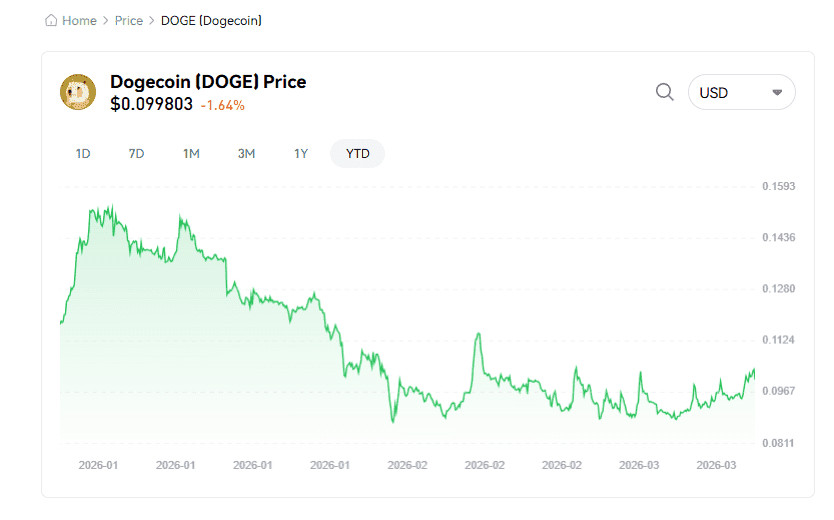
Current Price (March 2026)
|
~$0.09-$0.10
|
|
Market Cap
|
~$13-15 billion
|
|
ATH
|
$0.731 (May 2021)
|
|
From ATH
|
-87%
|
The most important technical detail is the supply schedule. There is no maximum supply. Every block (roughly once per minute) creates 10,000 new DOGE tokens, which adds approximately 5.26 billion DOGE per year to circulation, forever. That permanent inflation means holders need constant new demand just to maintain price. It is the fundamental structural headwind that has defined DOGE's economics since inception, and it is also the reason transaction fees stay so low (the network doesn't need high fees because block rewards fund security indefinitely).
Why Dogecoin Survived While Thousands of Projects Died
Most altcoins from 2013-2015 are gone. DOGE is not, and the reasons are worth understanding because they explain both its resilience and its limitations.
Brand recognition. The Shiba Inu meme has more cultural penetration than the vast majority of crypto projects will ever achieve. People who have never heard of Solana or Polkadot know what Dogecoin is. In a market where attention is the scarcest resource, DOGE has an unfair advantage.
The Musk factor. Elon Musk has called Dogecoin his "favorite cryptocurrency," Tesla accepted DOGE for merchandise in 2022, and his persistent public engagement with the token creates a floor of attention (and speculative interest) that no other altcoin benefits from. This relationship is unique to DOGE and is the primary reason the token trades at a multi-billion dollar market cap despite having no smart contract functionality and unlimited supply.
Genuine utility for micro-payments and tipping. At $0.03 per transaction with 1-minute confirmations, DOGE is a genuinely functional payment network for small transfers. It is faster and cheaper than Bitcoin for tipping, donations, and micro-payments. This is a real use case, even if it represents a tiny fraction of DOGE's total trading volume.
Community loyalty. With over 8.17 million holders as of 2026, DOGE's community is large, active, and remarkably persistent. Holders tend to hold through drawdowns rather than selling, which creates a supply floor even during bear markets.
The Three Catalysts That Make 2026 Different
-
X Money (April 2026 Public Access)
Elon Musk confirmed on March 10, 2026, that X Money will enter early public access in April. The platform offers peer-to-peer payments, bank deposits, a Visa-backed debit card, 6% yield on balances, and cashback rewards. It is essentially a Venmo competitor built inside X's 600 million+ user base.
The critical detail for DOGE holders: X Money launches as a fiat-only product. There is zero confirmed crypto functionality in the initial release. Musk did repost a third-party projection that included future crypto integration, but that was not an official announcement. X's head of product Nikita Bier said in February that crypto trading tools would come to X through "Smart Cashtags" but clarified the platform would not execute trades or act as a brokerage.
DOGE surged roughly 8-11% on the announcement day anyway, with trading volume spiking 127% to $2.27 billion. The Dogecoin official X account encouraged businesses to "just accept Doge" instead of paying 2-3% credit card fees. The community is treating integration as inevitable, but the honest assessment is that it remains speculation.
If X Money eventually adds DOGE support, it would expose the token to 600 million+ users for peer-to-peer tipping and payments, which would be the largest potential utility unlock in DOGE's history. If it never adds DOGE, or adds it at a scale that falls below expectations, the single most anticipated catalyst fails.
-
DOJE ETF (Live Since September 2025)
The REX-Osprey DOGE ETF (ticker: DOJE) launched on the Cboe BZX Exchange on September 18, 2025, as the first US-listed Dogecoin ETF. It pulled in nearly $17 million in first-day trading volume and was described as surprisingly strong by Bloomberg analysts.
One important caveat: DOJE is not a true spot ETF in the same way that BlackRock's IBIT holds actual Bitcoin. DOJE uses financial derivatives through a Cayman Islands subsidiary to create a "synthetic" position that mimics DOGE's price. As the prospectus states: "Investing in DOJE is not equivalent to investing directly in Dogecoin." This structure carries a 1.50% expense ratio, significantly higher than spot BTC or ETH ETFs, and its tracking may diverge from actual DOGE price over time.
That said, the ETF's existence matters structurally. It provides regulated access through traditional brokerage accounts, opens DOGE to retirement portfolios, and creates a precedent that Bitwise and Grayscale can reference in their own DOGE ETF applications.
-
DogeOS and Such App Development
The Dogecoin Foundation and House of Doge announced "Such App," a self-custodial DOGE wallet targeting H1 2026. Proposals are also circulating for zero-knowledge proof scaling and Layer-2 "DogeOS" infrastructure. These are still in early stages, and the Dogecoin Foundation is a much smaller operation than the development organizations behind Ethereum or Solana, but they signal active work beyond meme maintenance.
The Honest Risk Picture
Unlimited supply is the permanent headwind. 5.26 billion new DOGE are created every year with no cap and no halving schedule. At current prices, that is roughly $475 million in annual new supply that must be absorbed by buyers. Every year. Forever. For context, that annual inflation dilutes holders by approximately 3.6% per year at the current circulating supply, and the dilution rate only decreases as the denominator grows (it never stops entirely).
No smart contracts means no DeFi participation. DOGE cannot be used natively in lending, borrowing, yield protocols, or any of the complex applications that drive on-chain activity for Ethereum, Solana, or newer Layer-1 chains. This limits the token's utility to payments, tipping, and speculation.
Sentiment-driven price action. DOGE's price correlates more strongly with Musk's public comments and broader market sentiment than with any on-chain metric. This creates explosive upside during hype cycles and violent downside when attention fades. The 87% drawdown from the May 2021 ATH to current prices illustrates the risk profile.
X Money speculation could fail. The biggest catalyst in the DOGE thesis today is a product that has not confirmed any crypto integration. If X Money launches in April with fiat-only functionality and crypto features take months or years to follow (or never arrive at a meaningful scale), DOGE's most anticipated catalyst becomes a non-event. This is still the base case, regardless of community expectations.
What Makes DOGE Genuinely Different From Other Meme Coins
Despite all the risks, DOGE has attributes that separate it from the thousands of meme tokens that come and go each cycle.
|
Factor
|
DOGE
|
Typical Meme Coin
|
|
Age
|
12 years (since 2013)
|
Months to 2 years
|
|
Holders
|
8.17M+
|
Thousands to low millions
|
|
ETF
|
Yes (DOJE, live since Sep 2025)
|
No
|
|
Musk connection
|
Direct, persistent, unique
|
None or one-time mention
|
|
Transaction utility
|
Real ($0.03 fees, 1-min blocks)
|
Usually zero utility
|
|
Daily volume
|
$2B+
|
Often under $50M
|
|
Development roadmap
|
Such App, DogeOS, ZK proposals
|
Usually none
|
These are real attributes. They justify DOGE's survival and its premium over other meme coins. They do not, however, justify the price on fundamentals alone. DOGE trades at its current level primarily because of the Musk-X narrative, brand recognition, and speculative interest, not because on-chain usage or revenue warrants a $13-15 billion market cap. That distinction matters for how you size a position and what your time horizon looks like.
Frequently Asked Questions
Is Dogecoin a good investment?
DOGE is a high-conviction speculative trade, not a fundamental investment. The X Money catalyst could be transformative if it materializes, the ETF provides institutional access, and the brand is stronger than 95% of altcoins. But unlimited supply, no smart contracts, and heavy dependence on Musk's engagement make it a position you size for the upside scenario while being prepared for the downside.
Will X Money integrate Dogecoin?
Not confirmed. The April 2026 launch is fiat-only. Musk has hinted at crypto features repeatedly but has never committed to a specific token or timeline. The community expects integration, and it may happen eventually, but treating it as certain is a mistake.
How does DOGE compare to SHIB?
DOGE has a 12-year track record, 8M+ holders, a live ETF, and a direct Musk connection. SHIB has Ethereum-based smart contract access (ShibaSwap, Shibarium L2) and a burn mechanism that DOGE lacks. DOGE wins on brand and institutional access. SHIB wins on technical flexibility. They serve different niches within the meme coin category.
Does DOGE have a maximum supply?
No. 10,000 DOGE are created every block (~1 minute), adding approximately 5.26 billion new tokens per year, forever. There is no cap, no halving, and no mechanism to reduce this issuance. The inflation rate decreases relative to the growing total supply (currently ~3.6%/year) but never reaches zero.
Bottom Line
Dogecoin should not exist at a $13-15 billion market cap based on its technical specifications. Unlimited supply, no smart contracts, and $962,000 in total annual network fee revenue do not justify that valuation. But DOGE has never traded on fundamentals, and understanding that is the first step to trading it effectively.
What DOGE has is a brand that outlasted every crypto cycle since 2013, a direct connection to the world's most influential technology figure, the first meme coin ETF, and a potential integration into a 600 million-user payment platform. Those are real edges in a market driven by attention and narrative. The question is how much of that narrative has already been priced in at $0.09-$0.10, and how much upside remains if the catalysts actually deliver. If you trade DOGE, size for the volatility and set your exits before the catalysts confirm or fail, not after.
This article is for educational purposes only and does not constitute financial or investment advice. DOGE is a highly volatile, sentiment-driven asset with unlimited supply inflation. Past price performance does not predict future results.
