









Key Takeaways
Chain abstraction is a UX and infrastructure approach that makes multiple blockchains feel like one system to the end user.
Its goal is to remove manual friction such as bridging, holding multiple gas tokens, switching chains, and routing transactions manually.
Common implementations include universal accounts, unified balances, intent-based execution, solver networks, gas abstraction, and cross-chain routing infrastructure.
Chain abstraction is not the same as account abstraction. Account abstraction changes how accounts work; chain abstraction changes how users experience multiple chains.
As of April 2026, chain abstraction is being pushed by infrastructure players such as Particle Network, SOCKET, OneBalance, NEAR, and others, each with different technical designs.
One of crypto’s biggest problems is no longer whether blockchains work. It is whether normal people can use them without feeling like they are operating a piece of infrastructure.
Today’s Web3 experience is still fragmented. Users often need to choose the right chain, bridge funds manually, hold different gas tokens, switch RPC networks, and understand which app works where. Chain abstraction is the idea that users should not have to think about any of that. Chainlink’s March 2026 explainer defines chain abstraction as a user-experience framework that unifies fragmented blockchain networks into a single interface, letting people interact with decentralized applications without manually managing bridges, gas tokens, or chain-specific technical details. Particle Network describes it similarly: users interact with Web3 as if it were one unified environment, with one account and balance across chains and no need for chain switching.
In simple terms, chain abstraction means hiding blockchain complexity so users can focus on outcomes instead of infrastructure. A user should be able to say, “swap this token,” “bridge my funds,” “buy that asset,” or “use this app,” without first solving a networking problem. SOCKET, OneBalance, NEAR, and other infrastructure providers all frame chain abstraction around this same core idea: removing chain-specific friction and making multiple networks feel like one usable system.
That is why chain abstraction has become one of the most important infrastructure narratives in crypto. As the ecosystem expands across Ethereum, rollups, appchains, Solana, and other execution environments, the biggest UX challenge is no longer access to one blockchain. It is access to many blockchains without cognitive overload.
What Is Chain Abstraction?
Chain abstraction is the attempt to make blockchain networks invisible to the user.
That does not mean chains disappear technically. Ethereum, Base, Arbitrum, Solana, Bitcoin, and other networks still exist, with different execution models, security assumptions, assets, and messaging standards. What changes is the interface. Instead of asking the user to manage those differences directly, a chain-abstracted system handles them under the hood. Chainlink’s definition emphasizes that underlying infrastructure becomes invisible to the end user, while CoinMarketCap’s glossary similarly describes chain abstraction as an application- and infrastructure-layer paradigm that prevents end users from needing to be aware of or manually interact with different networks.
A good mental model is the internet. Most users do not think about routing packets, DNS lookups, server handoffs, or content delivery networks when they open a website. They just expect the page to load. Chain abstraction aims to bring that same experience to Web3: users want the result, not the networking diagram. This comparison is an inference, but it matches how multiple protocol teams describe the goal of making many chains behave like one environment.
If successful, chain abstraction would make crypto feel much less like juggling infrastructure and much more like using software.
Why Chain Abstraction Matters
Crypto has scaled by adding more chains, but that growth created fragmentation.
A few years ago, users mostly worried about one network at a time. Today, a single user may hold assets on Ethereum, Base, Arbitrum, Optimism, Solana, and more. Each environment can have different wallet behavior, gas assets, bridges, liquidity pools, security assumptions, and applications. Chain abstraction matters because asking users to manually coordinate all of that is a recipe for mistakes and drop-off. OneBalance’s docs explicitly say the goal is to remove onchain complexity like chains, bridges, and gas from the app experience, while Particle says chain abstraction gives users one account and one balance across chains.
This is not just a convenience feature. It affects adoption, retention, conversion, and capital efficiency. If users must manually pre-fund multiple chains, they leave capital idle. If they need to understand routing, they make more errors. If they have to bridge first before using an app, they are more likely to abandon the transaction. Relay’s March 2026 explainer and OneBalance’s product materials both emphasize this by focusing on one-click cross-chain actions and avoiding pre-funding across multiple networks.
For developers, chain abstraction also matters because it changes the design target. Instead of building separate experiences for each chain, teams can build applications that access users, assets, and actions across chains through one layer. SOCKET’s docs state that the protocol enables developers to build applications that leverage multiple blockchains as if operating on a single one.
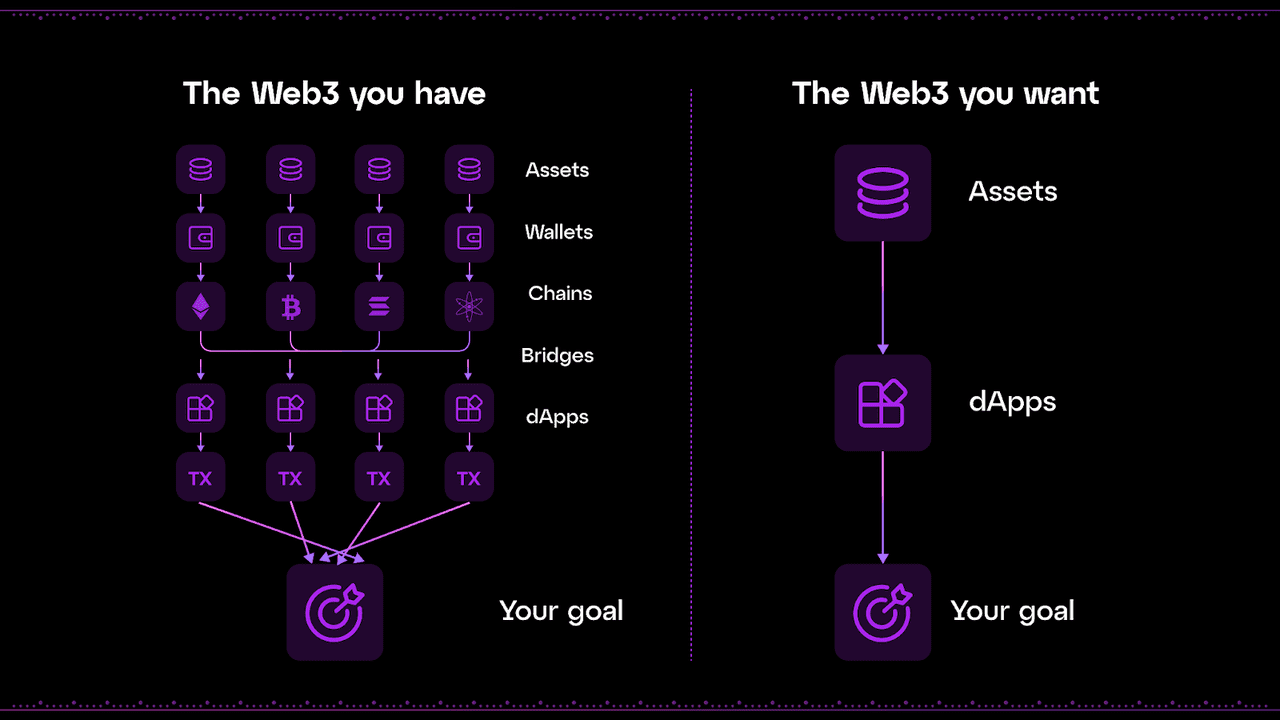
Chain Abstraction Solution (source)
What Problems Does Chain Abstraction Solve?
The easiest way to understand chain abstraction is to look at the pain points it is trying to remove.
Manual Chain Switching
Most users have experienced the “wrong network” problem. A wallet is connected to one chain, but the dApp needs another. The user must switch networks and hope the app state updates correctly. Chain abstraction tries to remove that step entirely by handling the network logic in the background. Particle explicitly says users should not need to worry about network switching.
Bridge Complexity
Moving assets across chains is still one of the most confusing parts of Web3. Users must choose bridges, estimate fees, wait for settlement, and trust routing mechanisms they may not understand. Chain abstraction tries to fold bridging into a broader execution layer so users request outcomes rather than manually choosing the bridge path. OneBalance, NEAR, and Relay all describe systems where the user simply requests the result and the infrastructure handles the cross-chain movement.
Gas Token Fragmentation
On a fragmented multi-chain stack, users often need ETH on Ethereum, ETH on Base, ETH on Arbitrum, SOL on Solana, and so on. That is cumbersome and capital-inefficient. Chain-abstracted systems increasingly promise gas abstraction, where the user can pay in a preferred token or where the infrastructure sponsors and settles gas behind the scenes. Particle’s docs say users can use any token as gas on any transaction, while chain-abstracted products often emphasize gasless or abstracted transactions.
Fragmented Balances
Users often think in total portfolio value, but wallets and dApps force them to think in chain-specific balances. Chain abstraction aims to present a unified balance or account state, even if assets are physically distributed across networks. Particle’s “unified balance” language is one of the clearest examples of this design goal.
Developer Fragmentation
Developers also suffer from chain sprawl. Supporting many chains often means handling different messaging patterns, bridge integrations, gas models, and execution assumptions. Chain abstraction lets teams build toward one higher-level interface. SOCKET and OneBalance both pitch this developer advantage directly.
How Chain Abstraction Works
There is no single architecture for chain abstraction. Different projects solve the problem in different ways. But most implementations combine several recurring components.
Universal or Multi-Chain Accounts
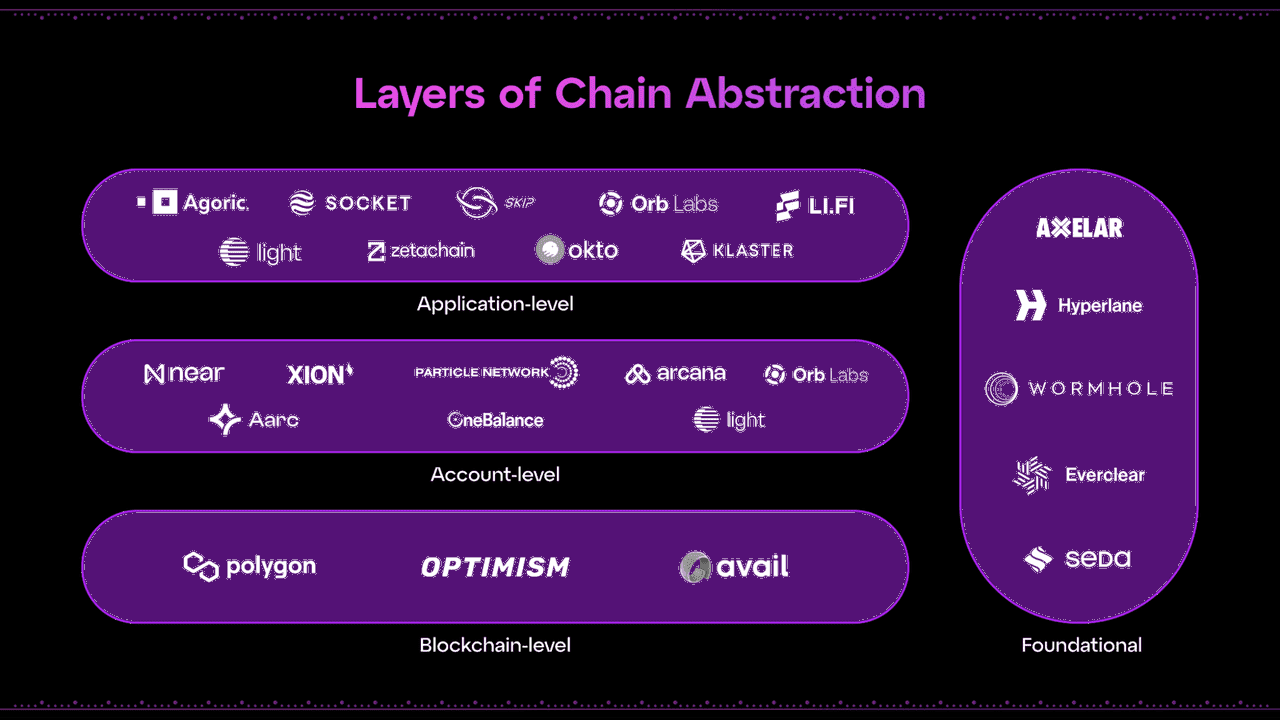
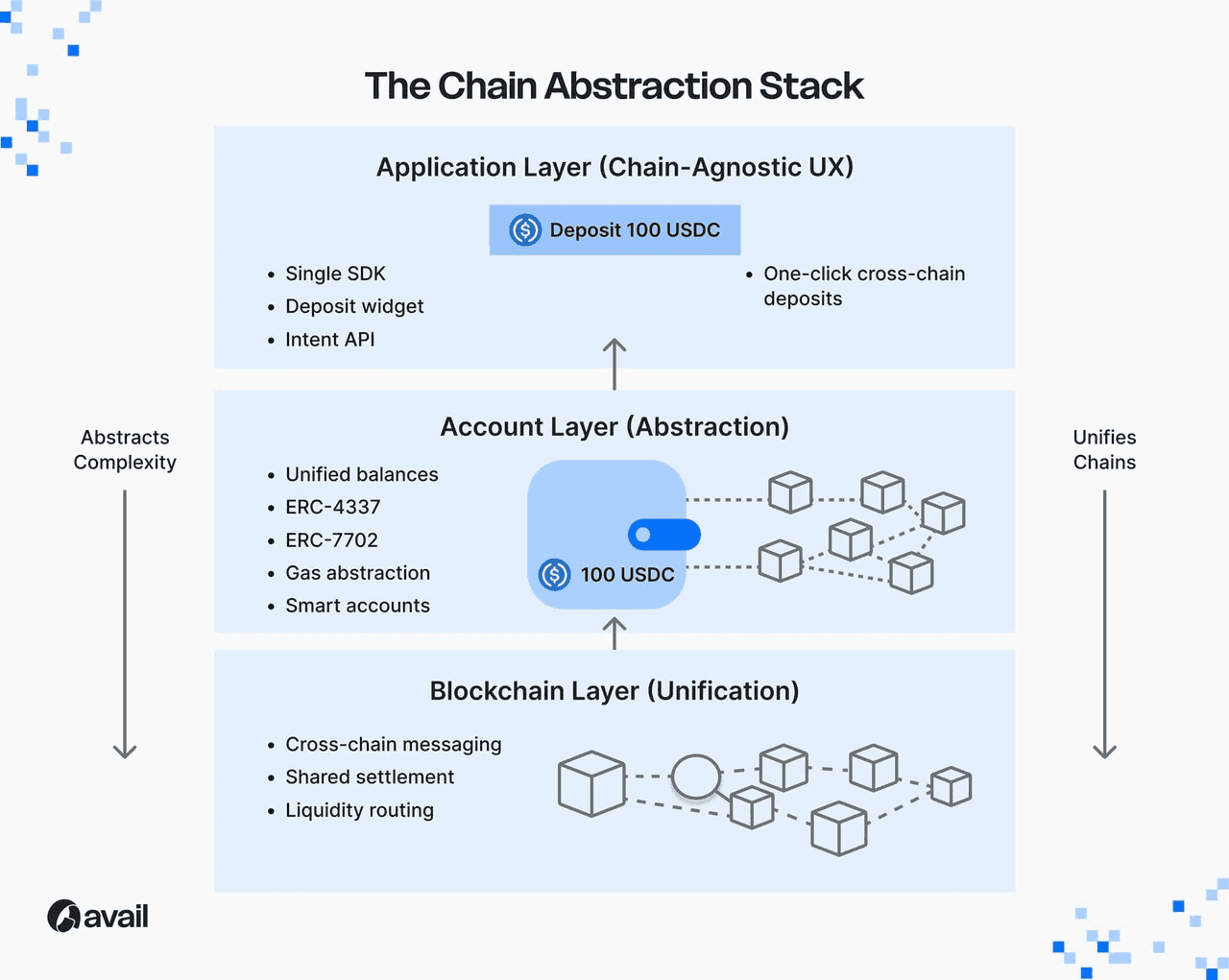
One common approach is the universal account model. Particle Network’s docs describe Universal Accounts as the core of its chain abstraction approach, allowing users to interact with any supported dApp on any supported chain through a single account and unified balance. NEAR’s chain abstraction materials describe something related through multi-chain accounts and chain signatures, where a NEAR account or smart contract can sign transactions for other chains.
The key idea is that the account becomes the user’s primary interface, not the individual chain.
Intent-Based Execution
Another major pattern is intents. Instead of specifying every step, the user expresses a desired outcome: “swap BTC for ETH,” “bridge this to Base,” or “buy this asset at best execution.” NEAR’s docs highlight intents explicitly, describing a system where users state desired outcomes and solvers compete to fulfill them optimally.
This is powerful because it flips the interaction model. The user no longer acts as their own router. The infrastructure becomes responsible for finding and executing the best route.
Solver Networks and Offchain Agents
To fulfill intents or route transactions efficiently, many chain-abstraction systems rely on solvers, relayers, or offchain agents. SOCKET’s architecture docs say it uses a combination of offchain agents and onchain contracts to enable flexible and efficient chain-abstracted interactions.
This means chain abstraction is often not “purely onchain” in the narrow sense. It usually involves orchestration layers that observe intent, route liquidity, manage settlement, and verify outcomes.
Gas Abstraction
Gas abstraction is one of the most visible user-facing benefits. Instead of making the user source the right gas token on the right chain, the infrastructure handles fee sponsorship, conversion, or settlement. Particle’s docs make this a headline feature, saying users can use any token as gas.
Resource Locking and Settlement Infrastructure
Some implementations also need mechanisms to ensure funds are available for fast execution without requiring users to pre-fund every destination chain. OneBalance’s docs mention resource locks and T+0 settlement design, showing that behind the smooth UX there is still serious settlement engineering happening in the background.
Chain Abstraction vs Account Abstraction
These two terms are often confused, but they are not the same thing.
Account abstraction changes how user accounts work. It makes wallets more programmable, safer, and easier to use. Ethereum.org explains account abstraction as a roadmap for making user accounts simpler and safer, and 1inch’s 2025 explainer says account abstraction redefines how users interact with the blockchain.
Chain abstraction changes how users experience multiple blockchains. It makes chain boundaries less relevant and reduces the need to think about where the interaction happens. 1inch summarizes the distinction clearly: account abstraction changes how users interact with the chain, while chain abstraction changes where that interaction takes place.
In practice, the two can work together. Smart accounts can serve as the wallet layer, while chain abstraction handles multi-chain routing, balances, and execution. But they solve different problems.
Common Features of Chain-Abstracted Apps
When users hear “chain abstraction,” what should they actually expect from a product? Usually some combination of the following:
One Account
The user signs in once and uses one identity across many chains. Particle and NEAR both emphasize this pattern.
One Balance View
Assets across chains may be surfaced as one usable balance or spendable pool rather than isolated silos. Particle’s docs explicitly use “unified balance” language.
No Manual Bridge Step
The app handles routing and settlement internally. Relay and OneBalance both market this outcome-first approach.
Any Token as Gas or Gasless UX
The user does not need to juggle native gas tokens for every destination chain. Particle’s docs highlight this directly.
Intent-Like Inputs
Instead of specifying every transaction step, users express desired outcomes and let the infrastructure handle execution. NEAR’s docs make this explicit.
Real Examples of Chain Abstraction in the Market
As of April 2026, several teams are pushing different versions of chain abstraction.
Particle Network
Particle frames chain abstraction as the foundation of its system, centered on Universal Accounts that give users one account and unified balance across dApps and chains, without bridges or network switching.
SOCKET
SOCKET describes itself as a chain-abstraction protocol that lets developers build applications leveraging multiple chains as if they were one. Its architecture uses offchain agents plus onchain contracts.
OneBalance
OneBalance focuses on API-based chain-abstracted experiences for exchanges, fintechs, and apps, emphasizing one-click cross-chain transactions with T+0 settlement and no need to pre-fund multiple chains.
NEAR
NEAR’s chain abstraction stack emphasizes chain signatures, multi-chain accounts, and intents, making it one of the more conceptually ambitious takes on the space.
Chainlink
Chainlink’s March 2026 article is useful because it does not just market one product. It gives a broader category definition: chain abstraction as a UX framework that unifies fragmented blockchain networks into one interface.
These examples show that chain abstraction is not one standard product yet. It is a family of approaches aimed at the same UX goal.
Benefits of Chain Abstraction
Better User Experience
This is the obvious one. Fewer steps means fewer mistakes and less abandonment. Most official materials in the space put UX first.
Better Capital Efficiency
Users no longer need to keep idle balances on multiple chains just to pay gas or prepare for future activity. OneBalance’s anti-prefunding pitch speaks directly to this.
Higher Conversion for Apps
If onboarding is smoother and transaction flows are shorter, apps should convert more users. This is an inference, but it follows directly from the design goals that these platforms emphasize.
Easier Multi-Chain Development
Developers can integrate one abstraction layer instead of many chain-specific workflows. SOCKET and OneBalance explicitly market this benefit.
Better Path to Mass Adoption
When users do not need to understand infrastructure to get value, products become much easier to adopt. This is partly inference, but it is also the central thesis behind most chain-abstraction marketing and educational material.
Risks and Limitations
Chain abstraction sounds great, but it is not magic.
Hidden Complexity Is Still Complexity
Abstraction does not remove complexity. It relocates it. Under the hood, someone still manages routing, settlement, bridges, liquidity, relayers, signatures, and security assumptions. If the abstraction layer fails, users may not even know where the failure occurred. This is an inference based on how these systems are architected with offchain agents and routing layers.
Additional Trust Assumptions
Some implementations rely on solvers, relayers, or infrastructure operators. Even when trust is reduced, it is often not eliminated. Users should ask who executes the route, who controls settlement, and what happens if the offchain layer fails. This is an inference from the architectural descriptions of these systems.
Security Surface Area
More moving parts usually mean more things that can break: account systems, bridge logic, routing contracts, relayers, solver incentives, and liquidity dependencies. Chain abstraction can improve UX but also widen the attack surface. This is a reasoned inference from the multi-layer designs described in docs.
Ecosystem Fragmentation
Ironically, the chain-abstraction sector itself is fragmented. There is no single universal standard yet. Different teams use different account models, routing assumptions, and trust designs.
Why Chain Abstraction Could Become a Major 2026 Narrative
As crypto becomes more multi-chain, the old model of “choose one chain and live there” stops working.
Users want access to apps, yield, payments, AI agents, RWAs, and trading opportunities wherever they are best, not wherever their current gas token happens to be. Chain abstraction is compelling because it aligns crypto with how software normally works: users express intent, software handles complexity, and infrastructure becomes mostly invisible. Chainlink’s recent category definition, along with the growth of products from Particle, SOCKET, OneBalance, and NEAR, shows that this is now a serious infrastructure race rather than a fringe concept.
It also pairs naturally with other fast-growing themes:
account abstraction
AI agents
intent-based DeFi
embedded wallets
That is because all of those trends benefit when blockchain boundaries become less visible. This is an inference, but it is strongly supported by the way these topics increasingly overlap in product design and infrastructure messaging.
Conclusion
Chain abstraction is the idea that users should interact with Web3 as one environment, not as a maze of separate chains.
It does not eliminate blockchains. It makes them less visible. Through universal accounts, unified balances, gas abstraction, solver networks, and intent-based execution, chain abstraction aims to hide the multi-chain complexity that still makes crypto difficult for ordinary users. Official materials from Chainlink, Particle, SOCKET, OneBalance, and NEAR all point in that same direction, even if they implement it differently.
As multi-chain crypto continues to grow, concepts like chain abstraction are becoming increasingly important for improving user experience and lowering barriers to adoption. For traders looking to stay ahead of emerging narratives—from chain abstraction and AI agents to RWAs and PayFi—Phemex offers a secure and user-friendly platform to explore the market, monitor new opportunities, and sharpen your trading edge.
