







Key Takeaways
-
ADI is an institutional blockchain ecosystem built around ADI Chain, an Ethereum Layer 2 designed for stablecoins, tokenized real-world assets, regulated finance, and government infrastructure.
-
ADI Chain uses zero-knowledge validity proofs to process transactions away from Ethereum before submitting proofs to Ethereum for final settlement.
-
The network is built on ZKsync technology, including the Atlas execution stack and Airbender prover, while remaining compatible with Ethereum applications and tooling.
-
Governments, institutions, and enterprises can deploy specialized Layer 3 domains with jurisdiction-specific compliance, privacy, identity, and operational controls.
-
The ADI token is used for gas, smart contract execution, settlement, ecosystem payments, and a treasury-backed staking program.
-
A central part of the ecosystem is DDSC, a regulated UAE dirham-backed stablecoin operating on ADI Chain.
-
ADI Foundation aims to bring one billion people in emerging markets into the digital economy by 2030, with an initial focus on the Middle East, Africa, and Asia.
A financial institution may need identity verification, transaction monitoring, jurisdiction-specific restrictions, audit trails, privacy controls, and clear accountability. A government deploying a national registry or digital payment system may also require control over who can operate infrastructure and how data is handled. ADI is attempting to bridge these requirements with blockchain’s transparency, programmability, and round-the-clock settlement.
The ecosystem is built around ADI Chain, an Ethereum Layer 2 designed for institutional and government use cases. Instead of competing only for crypto-native trading applications, ADI focuses on regulated stablecoins, real-world asset tokenization, cross-border payments, healthcare, identity, logistics, and public infrastructure.Its native token, ADI, provides the economic layer for transactions and applications operating across the network.
What Does ADI Refer To?
ADI Foundation
ADI Foundation is the Abu Dhabi-based organization responsible for developing and governing the wider ecosystem. It was founded by Sirius International Holding, the technology-focused subsidiary of International Holding Company.
The foundation works with governments, financial institutions, enterprises, and technology providers to support blockchain deployment in emerging economies. Its stated goal is to help bring one billion people onchain by 2030, particularly across the Middle East, Africa, and Asia.
ADI Chain
ADI Chain is the ecosystem’s blockchain network. It is an Ethereum Layer 2 that processes transactions outside Ethereum and uses zero-knowledge proofs to demonstrate that those transactions were executed correctly.
The network is optimized for use cases that require regulatory oversight, institutional controls, and high transaction capacity. These include stablecoins, tokenized securities, payments, digital identity, national registries, healthcare records, and logistics systems.
The ADI Token
ADI is the network’s utility token. It pays transaction fees, supports smart contract execution, acts as an ecosystem settlement asset, and can participate in the project’s treasury-backed staking model.
The token initially launched as an ERC-20 asset on Ethereum, allowing wallets, exchanges, and institutions to integrate it using familiar infrastructure. Within ADI Chain, it functions as the native gas token for the Layer 2 and associated Layer 3 domains.
Why Was ADI Created?
Blockchain adoption has largely been concentrated in crypto-native markets and a relatively small number of technologically developed economies. ADI Foundation argues that many emerging markets have not received the same benefits from digital finance and internet-based infrastructure. At the same time, governments and institutions often hesitate to deploy public blockchain systems because those networks may not include the controls required for regulated activity.
A permissionless application may allow any address to transact, but a regulated payment or securities platform may need to determine who may access the system, which assets can be transferred, what information must accompany a transaction, where data may be stored, and which entities are responsible for regulatory compliance. ADI’s answer is not to replace public blockchain infrastructure entirely. Instead, it combines an Ethereum-settled Layer 2 with customizable Layer 3 environments that organizations can adapt to their own laws, sectors, and operational requirements. The project’s long-term vision is a network of government and institutional domains connected through ADI Chain and, ultimately, the wider Ethereum ecosystem.
How Does ADI Chain Work?
ADI Chain is a zero-knowledge rollup, commonly called a ZK-rollup. A rollup processes transactions outside Ethereum’s main execution layer. Multiple transactions are collected into batches, allowing the Layer 2 to reduce the amount of information and computation that must be handled directly by Ethereum.
For each transaction batch, ADI Chain generates a zero-knowledge validity proof. This proof mathematically demonstrates that the resulting blockchain state follows the network’s rules. The proof is then submitted to an Ethereum smart contract. Ethereum verifies it before accepting the updated state as final. An invalid state transition should therefore fail verification rather than becoming part of the finalized chain.
-
A user submits a transaction to ADI Chain.
-
The sequencer orders and processes the transaction.
-
Multiple transactions are assembled into a batch.
-
The prover generates a validity proof for the batch.
-
The proof and required data are submitted to Ethereum.
-
Ethereum verifies the proof and finalizes the Layer 2 state.
This design allows ADI to provide faster and less expensive transactions while using Ethereum as its final settlement layer.
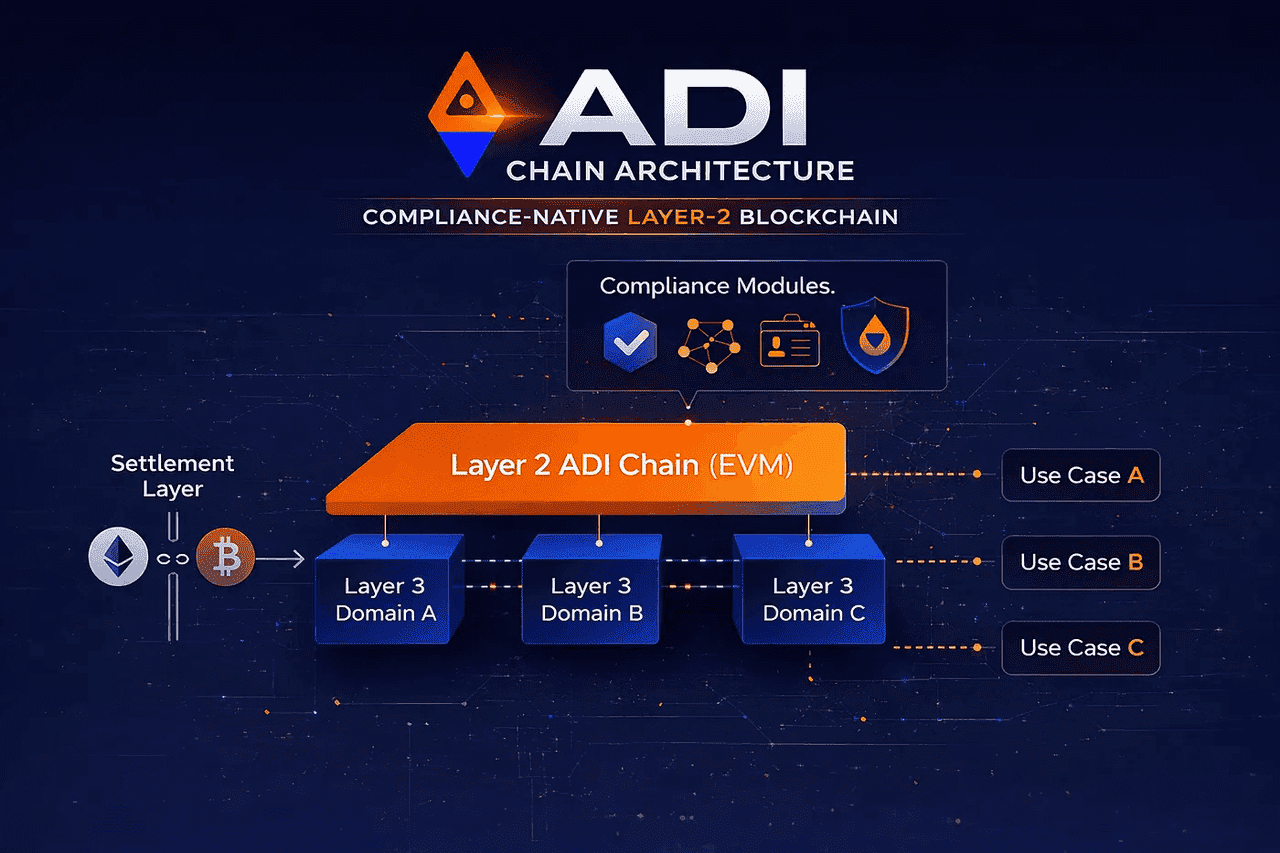
ADI Chain Architecture (source)
ZKsync Atlas and Airbender
ADI Chain is built using technology from the ZKsync ecosystem. Its documentation specifically identifies the Atlas and Airbender stacks as major components of its architecture. Atlas provides the execution environment used to process transactions and manage the Layer 2 state. ADI’s execution program can be compiled for conventional processors used by the sequencer and for the RISC-V architecture used by the Airbender proving system.
Airbender generates the zero-knowledge proofs that verify state transitions. The resulting proof can then be checked on Ethereum without Ethereum independently re-executing every individual transaction. This separation between execution and proof generation is what allows ZK-rollups to increase throughput while maintaining cryptographic verification.
According to ADI’s technical documentation, an individual ADI Layer 2 instance is designed to support approximately 2,000 to 10,000 transactions per second, depending on conditions and configuration. The project also estimates that batching and proof compression can reduce gas costs by roughly 90% to 95% compared with executing the same activity directly on Ethereum.
Ethereum Security and Settlement
ADI Chain does not attempt to operate as an isolated Layer 1. It uses Ethereum as the final authority for verifying its state. This provides several potential advantages. First, Ethereum’s validator network secures the contracts that verify ADI’s proofs. Second, assets can move between Ethereum and ADI through the network’s canonical bridge. Third, developers can access Ethereum-compatible standards, wallets, and application tooling.
However, an Ethereum-secured rollup is not identical to Ethereum itself. Users must also evaluate the Layer 2’s sequencer, bridge contracts, upgrade controls, proof implementation, data availability model, and emergency procedures. Ethereum settlement can provide an important security foundation, but the design and operation of the Layer 2 remain relevant to overall risk.
EVM Compatibility
ADI Chain is compatible with the Ethereum Virtual Machine, or EVM. EVM compatibility allows developers to use familiar tools and standards when building on ADI. Existing Solidity smart contracts can generally be deployed with limited modifications, while common Ethereum asset standards such as ERC-20 and ERC-721 are supported.
This lowers the barrier for developers already working in the Ethereum ecosystem. Rather than learning a completely new programming environment, teams can continue using familiar wallets, development frameworks, smart contract libraries, and auditing practices.
ADI also supports a canonical bridge for transferring assets between Ethereum and the Layer 2. Its architecture is designed to incorporate communication between Ethereum, ADI Chain, and specialized Layer 3 networks into the zero-knowledge proof system.
What Are ADI Layer 3 Domains?
One of ADI’s defining features is its support for customizable Layer 3 domains.
A Layer 3 is a specialized blockchain environment deployed above the ADI Layer 2. An institution, government, or application can configure its Layer 3 around a particular jurisdiction, industry, privacy requirement, or operational policy.
For example, different domains could be designed for:
-
regulated payments;
-
digital identity;
-
land or company registries;
-
tokenized securities;
-
healthcare information;
-
supply-chain management;
-
government benefit distribution;
-
or institutional settlement.
A financial Layer 3 may require verified identities and approved intermediaries. A healthcare network may prioritize data privacy and access controls. A government registry may limit transaction authority to licensed agencies.
ADI and the DDSC Stablecoin
One of ADI Chain’s most important use cases is DDSC, a UAE dirham-backed stablecoin. DDSC is designed to maintain a value of one token per UAE dirham. It is backed by dirham reserves, intended to support 1:1 redemption, and designed for continuous institutional settlement on ADI Chain. The stablecoin was initiated with involvement from International Holding Company and First Abu Dhabi Bank, with Sirius International Holding supporting deployment and institutional adoption. It operates within the UAE’s regulated digital payment framework.
DDSC can potentially support domestic and cross-border payments, corporate treasury transfers, trade settlement, merchant payments, programmable financial agreements, and tokenized asset settlement. The stablecoin is strategically important to ADI because transactions conducted on the network require gas. As DDSC activity expands, it could create recurring demand for ADI as the token used to process transactions.
DDSC also provides a real-world test of ADI’s broader thesis: that sovereign or institution-backed digital currencies can operate through blockchain infrastructure without abandoning regulatory oversight.
Real-World Asset Tokenization
ADI Chain is also designed for tokenized real-world assets, or RWAs. RWAs are blockchain-based representations of financial or physical assets such as government securities, funds, private credit, real estate, commodities, or company shares. Institutional tokenization requires more than creating a digital token. A compliant system may also need to manage investor eligibility, identity and sanctions screening, ownership records, transfer restrictions, corporate actions, settlement, custody, and cross-jurisdictional distribution.
ADI has partnered with infrastructure providers to bring these functions into its ecosystem. Its work with Zoniqx, for example, focuses on compliance-controlled RWA issuance, distribution, identity, and asset lifecycle management. ADI provides the underlying blockchain and settlement layer, while specialized platforms can provide issuance and compliance tools above it. This layered model reflects how institutional blockchain adoption is likely to develop. The base network provides execution and settlement, while regulated intermediaries and applications handle asset-specific legal responsibilities.
Regulated DeFi
ADI describes itself as infrastructure for regulated decentralized finance. Traditional DeFi protocols generally allow any compatible wallet to interact with a smart contract. Regulated DeFi introduces additional conditions, such as verified identities, approved jurisdictions, licensed issuers, and monitored transactions.
Possible applications include institutional lending pools, tokenized money-market products, compliant decentralized exchanges, stablecoin payment networks, collateralized financing, and on-chain securities settlement. ADI’s Layer 3 architecture allows these applications to implement policies without requiring the broader Ethereum ecosystem to follow the same restrictions.
Account Abstraction and User Experience
Blockchain wallets can be difficult for mainstream users because they often require seed phrases, manual gas management, and an understanding of transaction signing. ADI supports account abstraction technologies based on ERC-4337. Account abstraction allows wallets to behave more like programmable smart contracts rather than simple private-key accounts.
Applications can potentially use this infrastructure to offer biometric authentication, transaction limits, sponsored gas, account recovery, multiple authorization methods, and organization-specific approval policies. Developers may integrate third-party bundlers and paymasters or deploy their own smart-account infrastructure. The official non-custodial ADI Wallet also uses a smart-account implementation.
What Is the ADI Token Used For?
The ADI token provides the economic foundation of the network.
Gas Fees - ADI is the native gas token for ADI Chain and its associated Layer 3 domains. Users need it to transfer assets, execute smart contracts, and interact with decentralized applications. ZKsync’s custom gas-token functionality allows the network to use ADI rather than requiring users to hold ETH for every transaction.
Smart Contract Execution - Developers and applications consume ADI when deploying or executing smart contracts. This connects network usage with demand for the token.
Ecosystem Settlement - ADI can act as a medium of exchange between users, developers, enterprises, and ecosystem services. It may also provide a common settlement asset connecting different institutional Layer 3 environments.
Stablecoin and RWA Activity - Transactions involving DDSC, tokenized assets, or regulated applications require gas. Therefore, the token’s utility is tied partly to whether ADI Chain attracts meaningful financial activity.
Staking and Yield - ADI holders can participate in a treasury-backed staking pool and receive rewards. Official project materials state that these rewards are funded without minting additional tokens. This should not necessarily be interpreted as conventional proof-of-stake validation. ADI Chain is a ZK-rollup secured through Ethereum settlement, and the published staking model is described as treasury-backed rather than validator-based consensus staking.
ADI holders should therefore distinguish between planned governance capabilities and governance rights that are currently operational.
ADI Tokenomics (source)
The Bull Case for ADI
Most Layer 2 networks compete for similar crypto-native users, liquidity, and decentralized applications. ADI instead targets governments, banks, enterprises, regulated issuers, and emerging-market infrastructure. A second advantage is its connection to a live stablecoin use case. DDSC provides a tangible application that could generate repeated settlement activity rather than relying entirely on speculative trading. A third advantage is the Layer 3 model. Organizations can create specialized domains while remaining connected to a shared Layer 2 and Ethereum settlement layer. A fourth advantage is EVM compatibility. Institutions and developers can use established Ethereum tools rather than adopting a completely isolated technology stack.
Risks and Limitations
Institutional Adoption Risk - Government and enterprise sales cycles are slow. Announced partnerships do not always progress into large-scale production activity.
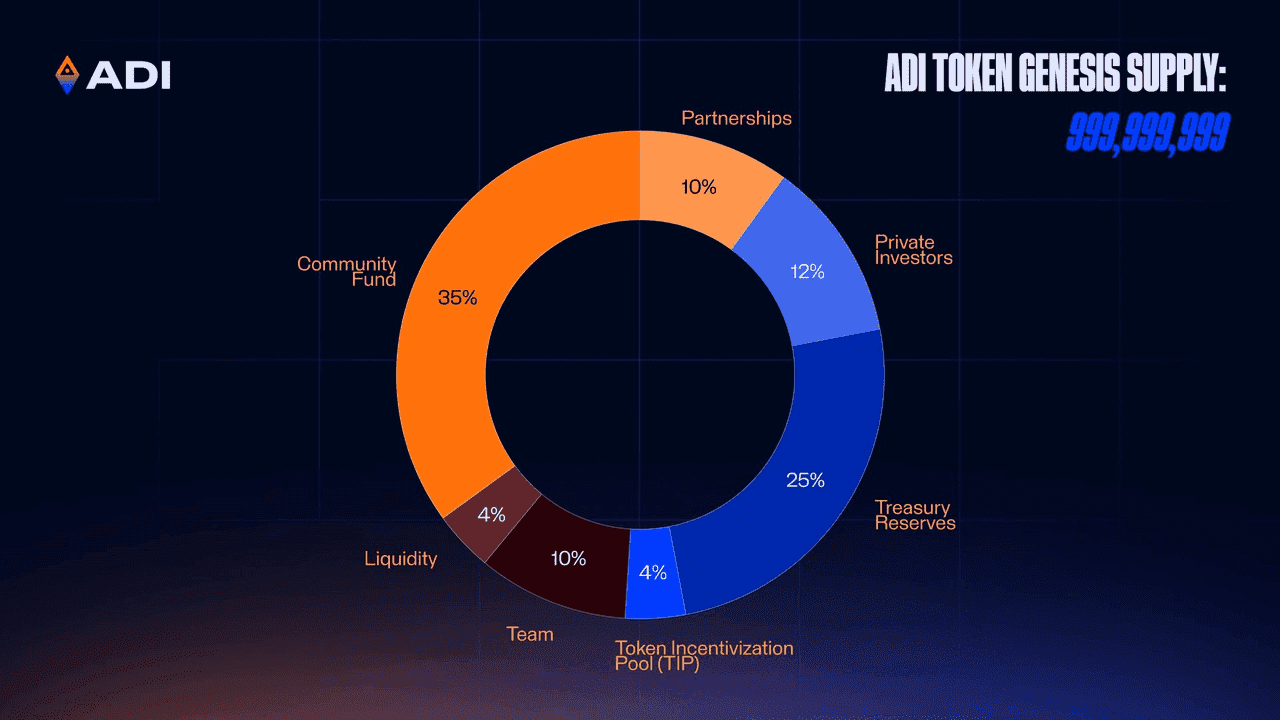
Token Dilution - Only a minority of the total ADI supply is circulating. Community, treasury, team, investor, and partnership allocations will continue unlocking for years.
High Fully Diluted Valuation - A high FDV means the project may already reflect considerable expectations for future adoption. Network growth must eventually justify that valuation.
Layer 2 Centralization - Like many early rollups, ADI may rely on centralized or controlled components such as sequencing, upgrades, governance, and operational infrastructure. Users should evaluate how these controls evolve over time.
Smart Contract and Bridge Risk - Zero-knowledge proofs do not eliminate all risks. Bugs in contracts, bridge infrastructure, wallet software, governance systems, or implementation logic can still lead to losses or disruption.
Regulatory Dependence - ADI’s institutional focus is an advantage, but it also makes adoption dependent on regulatory approval, licensed intermediaries, and jurisdiction-specific requirements.
Competition - ADI competes with Ethereum Layer 2s, enterprise blockchain platforms, institutional networks, and other chains focused on stablecoins and RWAs.
Compliance Tradeoffs - Identity checks, transfer restrictions, and administrator controls may make ADI applications suitable for regulated users, but they also reduce some of the censorship resistance and open access associated with permissionless DeFi.
What Is ADI in One Sentence?
Conclusion
ADI is attempting to build blockchain infrastructure for a market that public crypto networks have often struggled to serve: regulated governments, banks, enterprises, and national-scale financial systems. Its architecture combines Ethereum settlement, zero-knowledge proofs, EVM compatibility, custom gas functionality, and specialized Layer 3 domains. This gives organizations the ability to build controlled environments while remaining connected to a broader blockchain ecosystem.
The ADI token provides gas and settlement utility, while DDSC offers an early demonstration of the network’s institutional stablecoin thesis. Future RWA, payment, identity, healthcare, and government applications could expand that utility further.
However, ADI remains an emerging network. Its high fully diluted valuation, long token unlock schedule, institutional execution risk, and dependence on controlled infrastructure are important considerations. The central question is whether ADI can convert its institutional relationships and compliance-focused design into measurable transaction activity. If it succeeds, it could become an important settlement layer for regulated digital finance across the Middle East, Africa, and Asia.
