









Key Takeaways
-
A transfer agent is the party that maintains the official ownership records for a security and processes changes in ownership on behalf of the issuer.
-
In tokenized securities, the transfer agent often remains essential because moving a token on a blockchain does not automatically mean legal ownership has changed unless the official shareholder record is updated correctly.
-
Tokenization changes the format of the security, but it does not remove the need for recordkeeping, transfer controls, investor protections, and corporate-action processing.
-
A transfer agent in tokenized securities may manage a hybrid system where blockchain records and offchain shareholder records work together.
-
Transfer agents can play a central role in compliance, wallet whitelisting, transfer restrictions, cap-table accuracy, and corporate actions such as dividends or redemptions.
-
The broader significance of transfer agents is simple: they help connect the speed of blockchain rails with the legal reality of securities ownership.
Tokenized securities are often described as the future of capital markets. The pitch is easy to understand: take a stock, fund share, bond, or other security, represent it on blockchain rails, and gain benefits like faster settlement, better programmability, and potentially broader market access.
But there is a part of this system that many crypto users overlook. Even if a security is represented by a token, someone still needs to maintain the official ownership record. Someone needs to know who the real holder is, whether a transfer is valid, whether a wallet is eligible to receive the asset, and how dividends, splits, or redemptions should be processed. In traditional markets, that role is usually handled by a transfer agent.
That role does not disappear just because a security becomes tokenized. In fact, tokenization may make transfer agents even more important, because blockchain movement and legal ownership are not always the same thing. The token can move instantly, but the legal system still needs an authoritative record of who actually owns the security.
What a Transfer Agent Does in Traditional Securities
Before talking about tokenized securities, it helps to understand the basic traditional role. A transfer agent works for the issuer. Its core job is to record changes in ownership, maintain the issuer’s security holder records, issue and cancel certificates or their book-entry equivalent, and often help process dividends or other corporate actions. In simple terms, the transfer agent is one of the key parties responsible for maintaining the official shareholder register or equivalent ownership file.
That function matters because securities markets depend on accurate records. If investors buy and sell a security, the issuer and the market need to know who actually owns what. If a dividend is paid, a vote is held, or a split occurs, the right people need to receive the right entitlements. Historically, transfer agents did this in a world of paper certificates and centralized registries. Today, the role increasingly operates in book-entry systems. In tokenized securities, the same core responsibility remains, but the technology stack starts to change.
Why Transfer Agents Still Matter When Securities Are Tokenized
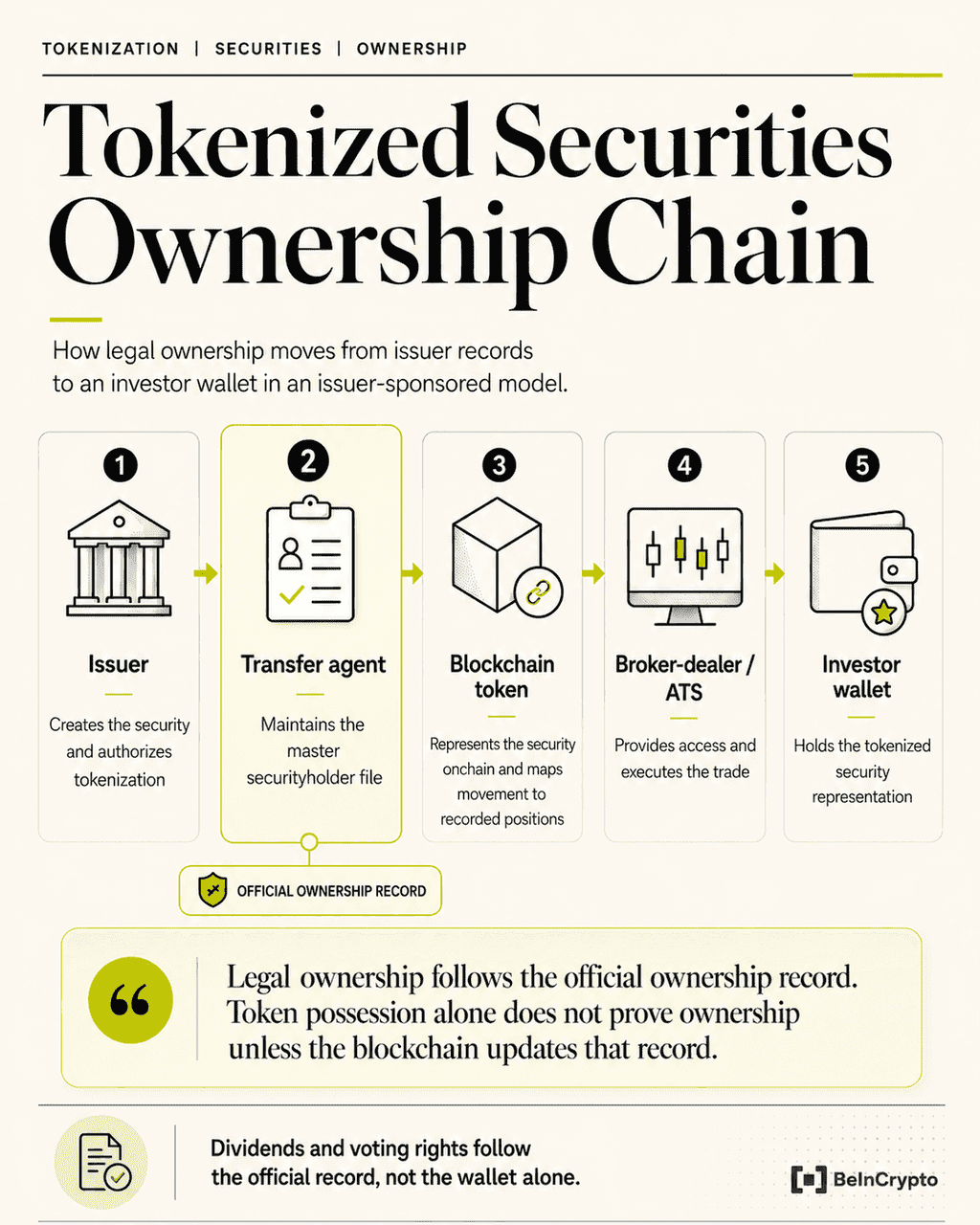
This is the most important concept in the whole topic. A tokenized security is still a security. The SEC’s recent staff statement on tokenized securities makes this very clear: tokenization changes the format or recordkeeping method, but it does not remove the legal reality of the underlying security. That means a token transfer on a blockchain is not automatically enough by itself. What matters legally is whether the issuer or its agent recognizes that transfer as a valid change in ownership on the master securityholder file.
This is where the transfer agent comes in. In many tokenized models, the transfer agent helps connect the blockchain record, the issuer’s official books, and the legal ownership framework. Without that connection, a token may look like a security on-chain but still fail to function as one in the real world. The transfer agent helps make sure the digital representation and the legal record stay aligned. That is why transfer agents remain so important in tokenized markets. Tokenization can modernize settlement and transfer mechanics, but it does not eliminate the need for an authoritative ownership register.
The Master Securityholder File
One of the best ways to understand the transfer agent’s role is through the idea of the master securityholder file. This is the authoritative record of who owns the security. In older systems, that record might have been maintained through certificates and centralized databases. In tokenized systems, the SEC has made clear that the official ownership record may involve one or more blockchain records, offchain records, or a combination of both. But the key point is that there still needs to be a definitive source of truth.
A transfer agent often maintains or helps maintain that source of truth. This means that in tokenized securities, blockchain records may be operationally important, but the transfer agent still helps ensure they map correctly to the actual legal record of ownership. That function becomes especially important whenever a token transfer occurs, a wallet needs to be linked to an investor identity, a restricted security cannot move freely, or an issuer needs to know exactly who its current holders are.
How Tokenized Transfer Agents Differ From Traditional Ones
The core responsibilities stay similar, but the workflow becomes more digital. A traditional transfer agent may process paper certificates, broker instructions, and conventional book-entry changes. A transfer agent in tokenized securities may instead deal with blockchain wallet addresses, on-chain transfer events, whitelist and permission controls, smart-contract-linked restrictions, and blockchain-integrated ownership ledgers.
This is why the market increasingly talks about digital transfer agents or transfer agents purpose-built for tokenized securities. In a tokenized model, the transfer agent may need to:
-
map investors to wallet addresses,
-
approve or reject transfers based on securities-law restrictions,
-
synchronize on-chain token movements with offchain ownership records,
-
handle token issuance and redemption,
-
and make sure the issuer’s official books remain accurate at all times.
So while the transfer agent still performs familiar functions, the tools are changing from certificate administration to digital record orchestration.
Direct Registration vs. Indirect Registration
This is another important concept in tokenized securities. DTCC’s recent tokenization materials explain that tokenized ownership can follow different models, especially direct registration and indirect registration.
Direct registration
In a direct registration model, the investor is recorded directly on the issuer’s books. This gives the issuer more visibility and makes the transfer agent’s role especially central, because the agent is helping maintain the direct relationship between issuer and holder. In tokenized securities, this model often fits well with smaller or more specialized offerings because it gives precise control over the shareholder record.
Indirect registration
In indirect registration, ownership is mediated through market infrastructure such as brokers, custodians, and depositories. This model is common in larger liquid securities markets because it scales more easily. In tokenized securities, indirect registration may still matter for institutional-scale markets, even if the asset itself has an onchain representation.
The key takeaway is that tokenization does not force one registration model. But in both cases, transfer-agent-style recordkeeping remains important because someone still has to maintain the integrity of the ownership chain.
Compliance and Transfer Restrictions
One of the biggest reasons transfer agents matter in tokenized securities is compliance. Not every security can move freely to every wallet. Depending on the asset, the issuer may need to enforce things such as investor eligibility rules, holding-period restrictions, jurisdictional limitations, and accredited-investor requirements. A transfer agent can help enforce these rules by controlling how ownership changes are recorded.
In practice, this may involve:
-
wallet whitelisting,
-
verification checks before token issuance,
-
blocked transfers to ineligible recipients,
-
or controlled redemptions and corporate actions.
This is one of the biggest differences between tokenized securities and ordinary crypto tokens. A normal token might be freely transferable at the smart-contract level. A tokenized security often cannot be, because the legal status of the asset matters. The transfer agent helps bridge that gap between crypto-style movement and regulated-market rules.
Corporate Actions in Tokenized Securities
Another overlooked area is corporate actions. Owning a tokenized security is not just about being able to transfer the token. It is also about receiving whatever rights or economic benefits the security provides. That can include dividends, interest payments, redemptions, conversions, stock splits, or voting-related communications, depending on the structure. Someone has to determine who is entitled to those actions and process them correctly.
That is another reason transfer agents remain essential. They help ensure the issuer knows who the rightful holders are as of the relevant date and that distributions or updates are handled consistently. In tokenized systems, these corporate actions may become more automated over time. But automation still needs a reliable ownership record underneath it. The transfer agent is often the party that helps make that possible.
Why Transfer Agents Matter for Tokenized ETFs and Funds
Transfer agents are especially important in tokenized funds, tokenized ETFs, and tokenized shares of investment products. Recent SEC filings and industry materials show that tokenized fund and ETF structures still rely heavily on an authoritative official share register. In these models, the transfer agent may maintain the official shareholder record while blockchain entries serve as digital representations tied to those shares.
This means the transfer agent does not become obsolete when a fund share is tokenized. Instead, it often becomes one of the most important parties in making sure the tokenized share and the real fund entitlement stay synchronized. That is also why tokenized funds often emphasize that the blockchain layer is integrated with, not separate from, the official ownership record.
Why Crypto Users Often Misunderstand This Role
Crypto-native users often assume that the blockchain is the record. In pure crypto assets like BTC or ETH, that is basically true. Ownership is defined natively on-chain. Tokenized securities are different. The blockchain record is often necessary, but not always sufficient.
The legal and regulatory framework still cares about the issuer, the shareholder register, transfer restrictions, regulated recordkeeping, and investor rights. That means tokenized securities cannot always behave like ordinary crypto tokens, even if they look similar at first glance. The transfer agent is one of the clearest examples of this difference. It represents the fact that tokenized securities still live inside a legal securities system, not only inside a blockchain system.
The Bigger Picture: Transfer Agents as the Bridge Layer
The best way to think about transfer agents in tokenized securities is as a bridge layer. They sit between:
-
the issuer and the investor,
-
the blockchain and the legal record,
-
the token transfer and the official ownership register,
-
and the promise of tokenization and the rules of securities law.
That role is likely to become more important as tokenized securities scale. As more stocks, fund shares, bonds, and private securities move on-chain, markets will need reliable ways to maintain authoritative records, enforce eligibility and restrictions, process corporate actions, and connect wallet-based transfers to legally recognized ownership. Transfer agents are one of the key pieces of infrastructure that make that possible.
Conclusion
A transfer agent may sound like an old piece of legacy market infrastructure, but in tokenized securities it remains highly relevant. That is because tokenization does not eliminate the need for official ownership records, transfer controls, investor protections, or corporate-action processing. It simply changes how those functions can be performed.
In many tokenized models, the transfer agent becomes the party that keeps the blockchain representation and the legal record of the security aligned. That makes it one of the most important components in turning tokenized securities from a technical demo into a real market structure. So the next time you hear about tokenized stocks, tokenized ETFs, or tokenized fund shares, remember this: the token may be what moves onchain, but the transfer agent is often what makes that movement count.
