









Key Takeaways
Pi Network is a real, operating crypto project, not just a concept. It has a live Open Network, its own Layer-1 blockchain, a wallet, browser, KYC system, and exchange integrations, and Kraken began PI spot trading in March 2026.
That does not automatically make PI a strong investment. Legitimacy and investment quality are different questions, and Pi still faces execution, token-supply, and utility risks.
As of April 28, 2026, PI was trading around $0.188, with a market cap near $1.93 billion, a circulating supply of about 10.29 billion PI, and a max supply of 100 billion PI. CoinMarketCap also showed PI about 93.7% below its all-time high of $2.98 from February 26, 2025.
Pi’s future depends less on hype than on utility. The strongest bullish arguments are Open Network launch, ecosystem expansion, KYC-based identity verification, and Pi Network Ventures’ $100 million utility push.
The biggest bearish risks are supply dilution, migration bottlenecks, and the challenge of converting a huge app user base into real economic demand for PI.
Few crypto projects divide opinion like Pi Network. To supporters, it is one of the most ambitious mass-adoption experiments in crypto: a mobile-first network built for everyday users rather than miners with expensive hardware. To critics, it has long looked like a project that grew faster in community size than in measurable on-chain utility. Both views contain some truth.
That is why the right question is not simply, “Is Pi Network a scam?” The more useful question is: what is Pi Network today, what has it actually delivered, where does the PI token stand now, and what would need to happen for its price and ecosystem to strengthen from here?
As of April 2026, Pi is no longer just a pre-mainnet idea. The project officially launched Open Network in February 2025, enabling external connectivity, exchange integrations, and broader interactions with the outside crypto ecosystem. It has also continued pushing KYC, wallet activation, second migrations, ecosystem tooling, and venture funding for utility-building startups.
So the balanced answer is this: Pi Network appears legitimate as a real project with real infrastructure, but its long-term value proposition is still unproven. That distinction matters, especially for anyone trying to evaluate Pi Network price and future rather than just its marketing.
What Is Pi Network?
Pi Network describes itself as a cryptocurrency and smart-contracts platform “secured and operated by everyday people.” Its white paper says the project’s mission is to build a cryptocurrency and smart-contracts platform for mass use, while Kraken’s March 2026 listing post describes Pi as a “social cryptocurrency, developer platform, and ecosystem” founded in 2019 by Stanford PhDs Nicolas Kokkalis and Chengdiao Fan.
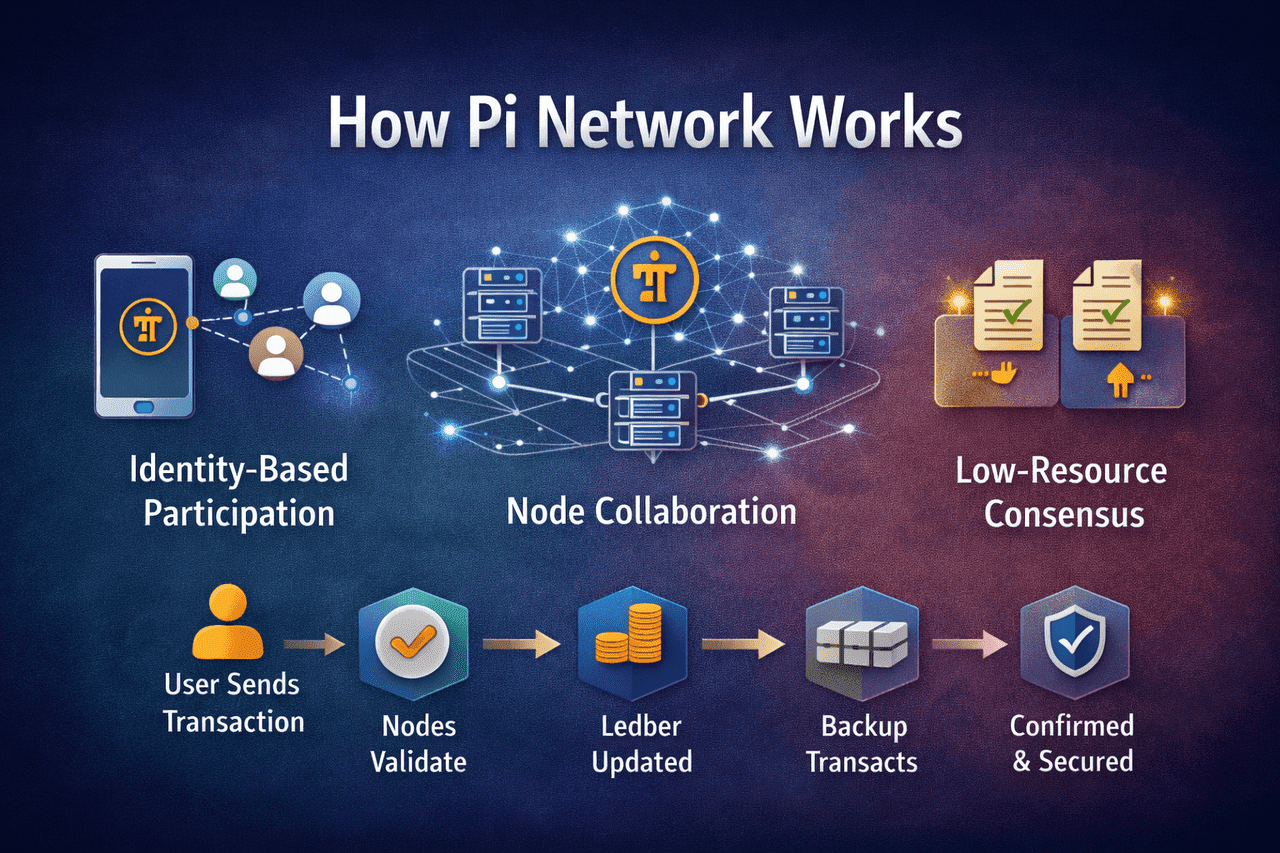
The project became widely known because of its mobile-first mining model. Rather than requiring proof-of-work hardware, Pi used an “energy-light” system centered on app engagement, security circles, and later ecosystem participation. That helped it attract a massive global user base long before it had external network connectivity.
Technically, Kraken says Pi runs its own Layer-1 blockchain and uses a consensus mechanism based on the Stellar Consensus Protocol, specifically a Federated Byzantine Agreement system. That is a meaningful point for legitimacy because it shows Pi is not just an app with reward points. It is presented as a real blockchain network with its own architecture.
Why People Have Questioned Whether Pi Network Is Legit
The skepticism around Pi Network did not come from nowhere.
For years, Pi had a huge community but limited external tradability. Critics saw a mobile app that encouraged daily engagement and referrals, yet did not provide the kind of open-market liquidity or ecosystem proof that more established crypto projects had. Because Open Network took years to arrive, many outsiders questioned whether the project would ever fully open up.
That skepticism was understandable. In crypto, delays matter. A project can be real and still overpromise, move slowly, or struggle to convert community scale into economic value. Pi’s long enclosed phase made it vulnerable to that criticism.
But the evidence looks different after 2025. Pi’s official Open Network launch post says external connectivity is now available, and the network supports integrations with centralized exchanges, onramps, and third-party services that have passed Pi’s KYB process. Kraken’s March 2026 announcement that PI trading is live adds an outside confirmation that PI is now being treated as a tradable crypto asset on a major exchange.
So the fairest assessment is that Pi Network is not vaporware anymore. It has crossed the threshold from closed ecosystem narrative into a live network with external connectivity. The debate now is less about whether it exists and more about whether its token economics and utility can justify lasting value.
What Pi Network Has Actually Delivered
This is the strongest case for Pi’s legitimacy: it has shipped meaningful milestones.
The biggest was Open Network, launched on February 20, 2025. Pi says this enabled external connectivity, exchange and onramp integration, and interaction with the broader blockchain world. That was arguably the project’s most important make-or-break milestone.
Since then, Pi has continued shipping ecosystem updates. Its June 2025 “100 Days of Open Network” post highlighted PiFest activity, saying the event saw over 125,000 registered sellers, more than 58,000 active sellers, over 1.8 million users of the community-built Map of Pi app, and more than 45,000 reviews submitted by users. Even if one remains cautious about how much of that translates into durable economic activity, those are real ecosystem metrics, not just slogans.
In 2025 and 2026, the network also kept working on the infrastructure layer: wallet activation, KYC progress, first and second mainnet migrations, KYC validator rewards, Pi Launchpad on testnet, and more developer-facing tools. Pi’s January 2026 update said it had reached 16 million Mainnet migrated Pioneers, while also noting that nearly 2.5 million additional users had been unblocked for migration.
Finally, Pi launched Pi Network Ventures, a $100 million initiative held in PI and USD to invest in startups and businesses that advance Pi utility and real-world adoption. That matters because it shows the team understands the core problem: a token with a huge user base still needs real usage.
Pi Network Price Today: Where PI Stands in April 2026
As of April 28, 2026, CoinMarketCap listed PI at about $0.1878, with a $1.93 billion market cap, about $29.5 million in 24-hour volume, and roughly 10.29 billion PI in circulating supply out of a 100 billion max supply. CoinGecko showed a very similar price around $0.1865–$0.1884.
CoinMarketCap also showed PI’s all-time high at $2.98 on February 26, 2025, and its all-time low at $0.1312 on February 11, 2026. At current levels, PI was still about 93.7% below that early post-launch peak.
That price history tells an important story. The market initially priced Pi with a lot of optimism after Open Network and early exchange access, but that enthusiasm did not hold. The token then repriced sharply lower as supply expanded and the market demanded harder proof of real usage.
In other words, the current market is not treating Pi like a finished success story. It is treating it like a large but still controversial network whose ultimate value remains uncertain.
Pi Tokenomics: The Biggest Reason Investors Stay Cautious
If there is one area where Pi investors need to stay disciplined, it is token supply.
Pi’s white paper and tokenomics materials say the maximum supply is 100 billion PI. The project says the community gets 80% and the Core Team 20%, with the community portion further split into 65% mining rewards, 10% foundation reserves, and 5% liquidity. Pi’s April 2025 tokenomics blog restates the same high-level breakdown.
That structure is not inherently illegitimate. Many crypto networks reserve large allocations for community incentives and ecosystem development. The issue is what it means for price.
When a token has a 100 billion max supply but only about 10.29 billion is circulating, future unlocks and migrations matter enormously. Even if demand improves, price has to absorb more supply over time. CoinMarketCap’s listing itself highlights the gap: roughly 10.29% of max supply was circulating as of April 28, 2026.
Pi’s white paper also makes clear that mining rewards and migrated balances are distributed over time, and that effective supply depends partly on KYC completion and migration progress. That means the token’s market structure is shaped not only by adoption, but by how quickly Pioneers complete migration and gain access to transferable tokens.
For investors, this is probably the single most important bearish point: Pi can be a real project and still face heavy dilution pressure.
The Bull Case for Pi Network’s Future
There is a real bullish case for Pi, and it rests on four pillars.
The first is scale. Pi spent years building a massive global base of users. Even critics generally concede that its reach is unusual. A large installed base does not guarantee success, but it gives Pi something many altcoins never achieve: a real distribution advantage. Pi’s official materials repeatedly frame this as a core strength.
The second is identity verification. Pi has leaned heavily into KYC and one-account-per-person design. Its CoinMarketCap project page says Pi follows a one-account-per-person policy through its KYC solution, while Pi’s January 2026 update described the project as a “massive identity-verified blockchain.” In a sector full of sybil attacks and airdrop farming, that does differentiate Pi from many purely speculative communities.
The third is utility building. Open Network, PiFest merchant activity, wallet activation, Pi App Studio features, and Pi Network Ventures all show a project trying to move from “widely held” to “widely used.” Pi’s venture initiative explicitly says its goal is to transform Pi from a widely held token into a widely used one. That is exactly the right problem to focus on.
The fourth is exchange access and broader market legitimacy. Kraken listing PI in March 2026 matters because it expands liquidity and gives Pi more visibility in mainstream crypto markets. Even if one exchange listing does not solve everything, it lowers the “this may never be truly tradable” objection.
If Pi can keep expanding external integrations, strengthen app-level demand, and make PI genuinely useful inside and outside its ecosystem, then its current price may eventually look like a reset rather than a terminal decline. That is the optimistic view.
The Bear Case for Pi Network’s Future
The bear case is just as real.
First, token supply is huge. A 100 billion max supply is not fatal on its own, but it means the network must create an enormous amount of real demand to support price over time. With only about 10.29 billion in circulation today, the future path of migrated and unlocked supply remains a structural overhang.
Second, utility is still not fully proven at global scale. Pi has shown merchant activity and ecosystem progress, but the market has already told us that activity alone is not enough. After all, PI remains far below its early 2025 highs. Investors are waiting for evidence that usage can become durable and economically meaningful, not just community-driven.
Third, migration and KYC remain operational bottlenecks. Pi’s own updates show ongoing work to unblock millions of users and continue first and second migrations. That is impressive from a scaling perspective, but it also highlights that the network is still in the middle of a complex transition rather than operating as a fully settled end-state system.
Fourth, Pi still has a credibility gap with part of the market. Years of slow rollout, referral-driven growth, and intense community promotion created skepticism that will not disappear overnight. Legitimacy in crypto is not just about existing. It is about consistently proving value in public markets. PI still has work to do there.
So, Is Pi Network Legit?
The cleanest answer is yes, Pi Network looks legitimate as a real crypto project. No, that does not mean its token is automatically undervalued or destined to succeed.
That answer fits the evidence best. Pi has a live network, a blockchain, a token, KYC, wallets, ongoing migrations, merchant activity, venture funding for ecosystem growth, and major exchange trading. Those are not the hallmarks of a fake project.
At the same time, legitimacy should not be confused with inevitability. Plenty of real projects fail to maintain value. In Pi’s case, the biggest open question is whether the network can generate enough sustained, real-world demand to offset supply growth and justify higher valuations over time.
Pi Network Price Forecast: What Could Drive PI Next?
There are three main drivers to watch.
The first is circulating supply growth. Investors should watch how fast migrated balances and other circulating tokens increase relative to new demand. Even strong ecosystem news can struggle to lift price if supply growth outpaces adoption.
The second is real utility expansion. Pi Network Ventures, Pi App Studio, merchant tools, domains, payments, and third-party integrations matter because they directly affect whether PI becomes a token people actually use instead of just hold or sell. That is the make-or-break variable.
The third is exchange and liquidity growth. Kraken’s March 2026 listing showed that major venues can expand PI access. More credible listings and deeper liquidity would likely help market confidence, though they can also increase volatility and give more holders a path to sell.
In the near term, PI’s future probably depends less on narrative and more on a simple equation: can the network create real economic demand faster than supply enters the market? If yes, price can recover. If not, the token may remain under pressure even as the ecosystem keeps developing.
Conclusion
Pi Network is no longer best understood as a speculative mobile-mining idea from crypto’s fringe. By April 2026, it is a live Layer-1 network with Open Network connectivity, ongoing ecosystem development, KYC-based migration, venture funding for builders, and exchange trading support from Kraken. On that basis, it looks legitimate as an operating project.
But the investment case is harder than the legitimacy case. PI’s current price around $0.188 reflects a market that is still cautious. The token sits far below its February 2025 high, and the large gap between circulating supply and max supply means dilution and migration dynamics remain central to any valuation discussion.
So the balanced verdict is this: Pi Network is legit enough to take seriously, but still too early to treat as proven. Its future will be decided by utility, liquidity, and token economics—not by community size alone.
