







On April 24, US Attorney Jeanine Pirro announced on X that her office was closing the criminal investigation into Federal Reserve Chair Jerome Powell, ending a four-month probe that had frozen the most consequential personnel change in central banking. Within hours, Polymarket bettors moved Kevin Warsh's confirmation odds from 28% to 97%, and Bitcoin traders began pricing in a push toward $90,000 as the path to a new Fed chair cleared for the first time since January.
The probe had centered on cost overruns at the Fed's $2.5 billion headquarters renovation in Washington, DC, not on monetary policy itself. But its political effects reached far beyond construction budgets. Republican Senator Thom Tillis had blocked Warsh's confirmation vote over what he called a "frivolous" investigation, and without Tillis the Senate Banking Committee lacked the votes to advance Trump's nominee. Pirro's decision to close the case removed that blockade and set up a committee vote for April 30, with full Senate confirmation expected before Powell's term ends May 15.
For crypto, this is not a legal story but a macro story with direct market consequences. The person who controls the Federal Reserve controls the interest rate environment, the pace of balance sheet reduction, and the regulatory posture toward digital assets. And the transition from Powell to Warsh represents the sharpest philosophical shift at the Fed since Paul Volcker replaced Arthur Burns in 1979.
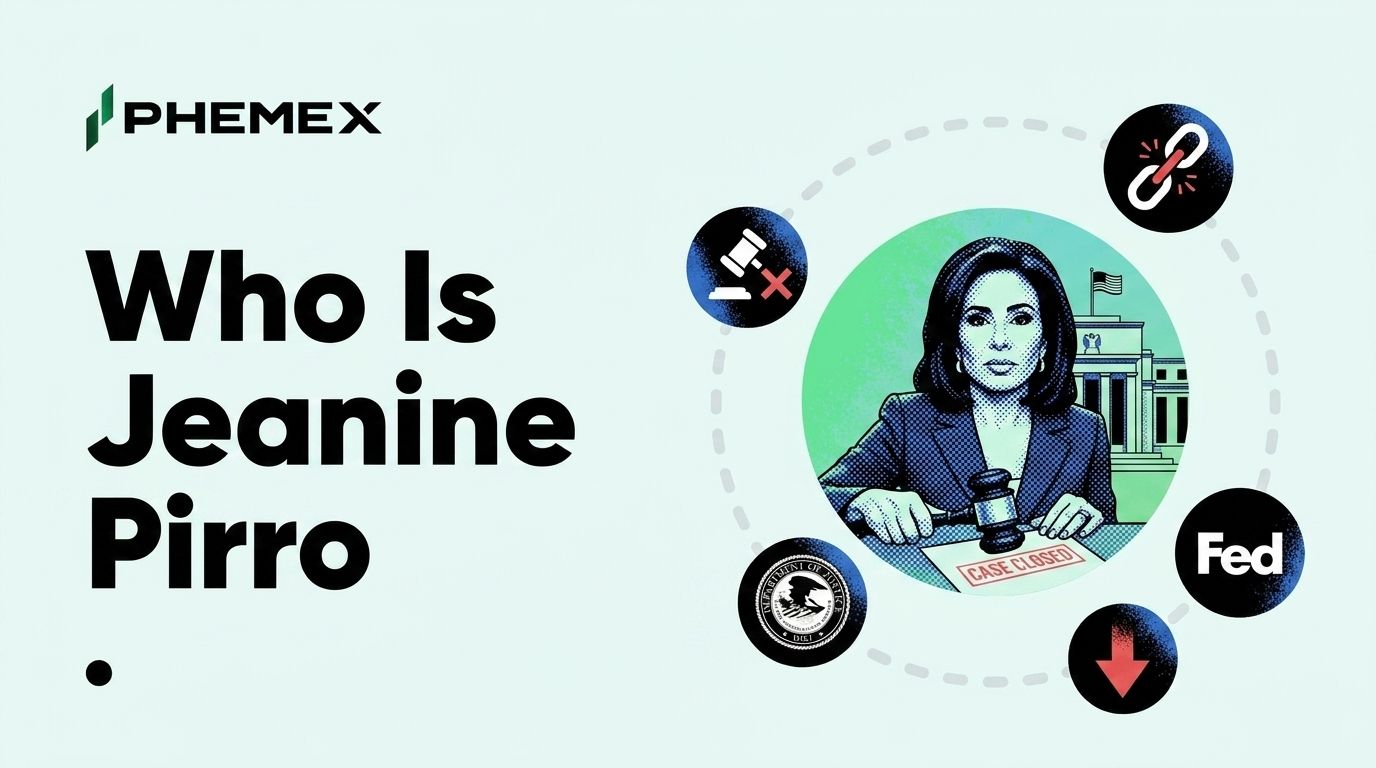
Who Is Jeanine Pirro
Jeanine Ferris Pirro was born on June 2, 1951, in Elmira, New York, to Lebanese-American parents. She earned her law degree from Albany Law School in 1975 and immediately entered prosecution, joining the Westchester County District Attorney's office in New York as an assistant DA.
Her career in Westchester built the resume that eventually led to Washington. She was elected judge of the Westchester County Court in 1990, the first woman to hold that seat, then won election as Westchester County District Attorney in 1993 and served three terms through 2005. Her office gained national attention for domestic violence prosecutions and elder abuse cases at a time when those categories received minimal law enforcement focus.
Pirro ran for the US Senate in 2005 against Hillary Clinton but withdrew to pursue the New York Attorney General race, which she lost to Andrew Cuomo. From 2011 through 2022, she hosted "Justice with Judge Jeanine" on Fox News, becoming one of the network's most-watched weekend personalities and a vocal supporter of Donald Trump.
Trump appointed Pirro as interim US Attorney for the District of Columbia in May 2025. The Senate confirmed her 50-45 on August 2, 2025, in a party-line vote. As US Attorney for DC, she oversees the federal jurisdiction that handles cases involving government agencies, including the Federal Reserve.
What the Powell Probe Was Actually About
The investigation had nothing to do with interest rates, monetary policy, or the Fed's handling of inflation. It was about a building.
The Federal Reserve's Martin Building and Eccles Building in Washington have been undergoing a multi-year renovation. The estimated cost rose from $1.9 billion to nearly $2.5 billion due to asbestos abatement complications, a higher-than-expected water table, and rising raw material costs. Trump had publicly accused Powell of mismanaging the project and allowing taxpayer money to be wasted, folding those accusations into his broader complaints about Powell refusing to cut interest rates fast enough.
Pirro's office launched a criminal investigation in January 2026, issuing subpoenas to the Federal Reserve. A federal judge quashed those subpoenas last month, ruling that the investigation lacked sufficient legal basis. Pirro initially said she would appeal the ruling, but on April 24 she reversed course and closed the case entirely. The Fed's Inspector General has agreed to review the renovation costs instead, and Pirro stated her office could reopen the criminal probe "should the facts warrant doing so" after that review concludes.
The legal substance of the probe was always thin. What mattered was its political effect on Warsh's confirmation.
Why Senator Tillis Held the Key
The Senate Banking Committee that approves Fed nominees is composed of 13 Republicans and 11 Democrats. With all Democrats expected to vote against Warsh, a single Republican defection would deadlock the committee 12-12 and prevent the nomination from reaching the full Senate floor.
Tillis was that potential defection. He described the Powell probe as politically motivated and refused to vote for Warsh until the investigation was dropped, arguing that confirming a new Fed chair while the DOJ was investigating the current one would undermine institutional credibility. His position was not about Warsh's qualifications. It was about the signal that a simultaneous probe and confirmation would send to markets.
Within hours of Pirro's April 24 announcement, Tillis confirmed he would vote to advance Warsh, clearing the committee blockade. The Banking Committee vote is scheduled for April 30, and full Senate confirmation is expected before Powell's term expires on May 15.
What the Warsh Transition Means for Monetary Policy
Kevin Warsh served on the Federal Reserve Board from 2006 to 2011, becoming the youngest governor in the Fed's history when he was appointed at age 35. During that period, he was the most prominent internal critic of quantitative easing, voting against the $600 billion QE2 bond-buying program and warning that it would distort asset markets and fuel inflation. After leaving the Fed, he spent years arguing that the post-pandemic QE was directly responsible for the 2021-2022 inflation spike that reached 9.1%.
His policy stance has evolved since Trump nominated him on January 30. During his April 21 confirmation hearing, Warsh told the Senate Banking Committee that "digital assets are already part of the fabric of our financial services industry" and pushed back against the idea that Trump had demanded rate cuts, stressing Fed independence. His financial disclosure revealed over $100 million in crypto-related investments across more than 20 projects, including Bitwise Asset Management, Solana, dYdX, and Polymarket.
The likely Warsh policy mix combines two forces that pull crypto in opposite directions.
Rate cuts. Warsh has argued that AI-driven productivity gains create a structurally disinflationary environment, giving the Fed room to lower short-term rates without reigniting inflation. Lower rates have historically been bullish for Bitcoin because they reduce the opportunity cost of holding non-yielding assets and push capital toward risk assets.
Faster balance sheet reduction. Warsh wants a smaller Fed balance sheet than Powell maintained. The balance sheet currently sits at roughly $6.6 trillion after QT ended in December 2025. Accelerating the runoff removes liquidity from the financial system, which historically pressures risk assets including crypto.
The net effect depends on which force dominates, and Warsh's first 100 days starting May 15 will reveal which side of that equation carries more weight for risk assets.
How Crypto Markets Reacted
The market response to the probe closure was immediate and directional. Bitcoin surged past $77,000 in the days following the April 24 announcement, extending a rally that has now added roughly 20% since early April when BTC was trading near $65,000. Spot Bitcoin ETFs pulled in $2.1 billion over eight consecutive days through April 23, pushing cumulative net inflows since launch past $58 billion and total ETF assets above $102 billion.
The probe closure mattered to traders for a specific reason. Uncertainty about Fed leadership is one of the few macro variables that cannot be hedged or modeled. When the investigation was active, there was a non-zero probability that Warsh's confirmation would fail, that Powell would be forced out under criminal pressure before a successor was ready, or that the Fed would enter a leadership vacuum at a time when markets were already navigating tariff-driven inflation fears and weakening GDP growth. Pirro's decision to close the case collapsed all of those tail risks into a single, predictable outcome. Warsh gets confirmed, Powell leaves on schedule May 15, and the transition proceeds in an orderly fashion.
Markets price certainty higher than they price favorable outcomes. BTC did not rally because Warsh is inherently bullish for crypto. It rallied because the path forward became legible for the first time in months.
The Bigger Picture for Fed Independence
The probe raised questions that extend beyond any single personnel transition. The US Attorney's office investigating the sitting Fed chair on the basis of building renovation costs, while the president who appointed that US Attorney was publicly demanding the same Fed chair cut interest rates, created a pattern that markets noticed.
Senator Elizabeth Warren and Senator Dick Durbin criticized Pirro's handling of the probe as politically motivated from day one. Reason magazine argued that closing the probe actually confirmed its political motivation, since a legitimate criminal investigation would not be dropped in exchange for an inspector general review and a senator's vote.
For crypto traders, the precedent matters because Fed independence is what gives monetary policy its credibility with bond markets. If future administrations can pressure the Fed through DOJ investigations, the dollar's stability as the global reserve currency comes into question. And when dollar credibility weakens, the fixed-supply thesis for Bitcoinand hard assets like gold gets stronger. BTC's best historical rallies have coincided with periods when monetary policy credibility was actively being debated.
Frequently Asked Questions
Who is Jeanine Pirro and why is she involved in the Fed probe?
Jeanine Pirro is the US Attorney for the District of Columbia, confirmed by the Senate in August 2025. As DC's top federal prosecutor, her office has jurisdiction over cases involving government agencies headquartered in Washington, which includes the Federal Reserve. She launched the criminal investigation into Fed Chair Powell in January 2026 over cost overruns at the Fed's headquarters renovation.
Why did the DOJ drop the criminal investigation into Jerome Powell?
Pirro closed the probe on April 24 after a federal judge quashed her subpoenas and Republican Senator Thom Tillis blocked Kevin Warsh's confirmation over the investigation. The Fed's Inspector General agreed to review the renovation costs instead. Pirro stated her office could reopen the criminal probe after that review if warranted.
How does the Powell probe closure affect Kevin Warsh's confirmation?
It removes the only remaining obstacle. Tillis was the swing vote on the 13-Republican, 11-Democrat Senate Banking Committee, and he refused to vote for Warsh while the probe was active. His agreement to vote yes after the probe closed means the committee can advance Warsh's nomination, with full Senate confirmation expected before Powell's term ends May 15.
Is the Fed leadership transition bullish or bearish for Bitcoin?
The answer is nuanced. Warsh favors rate cuts, which historically boost risk assets like BTC, but he also wants to shrink the Fed's balance sheet faster, which removes liquidity. The near-term effect has been bullish because the transition from uncertainty to clarity reduced tail risks, though the longer-term direction depends on how Warsh balances lower rates against tighter liquidity.
Bottom Line
Jeanine Pirro's decision to close the Powell probe did not change monetary policy by a single basis point. What it changed was the probability distribution around who controls monetary policy starting May 15. Markets moved because the path from Powell to Warsh went from contested and uncertain to effectively guaranteed, and that clarity is worth more to institutional capital than any specific rate decision.
The Senate Banking Committee votes April 30. If Warsh is confirmed on schedule, his first FOMC meeting as chair falls in June, and every signal from his confirmation hearing points toward a Fed that is friendlier to digital assets, more willing to cut short-term rates, and more aggressive about shrinking the balance sheet. BTC is trading around $77,700 as of late April 2026, up roughly 20% from early-month lows. The question traders should be asking is not if the Fed transition is priced in, but if Warsh's actual policy decisions starting in June will match the market's current expectations. If they do, $90,000 is the next level in play. If they disappoint, the rally stalls at resistance.
This article is for informational purposes only and does not constitute financial or investment advice. Cryptocurrency trading involves substantial risk. Always conduct your own research before making trading decisions.
