










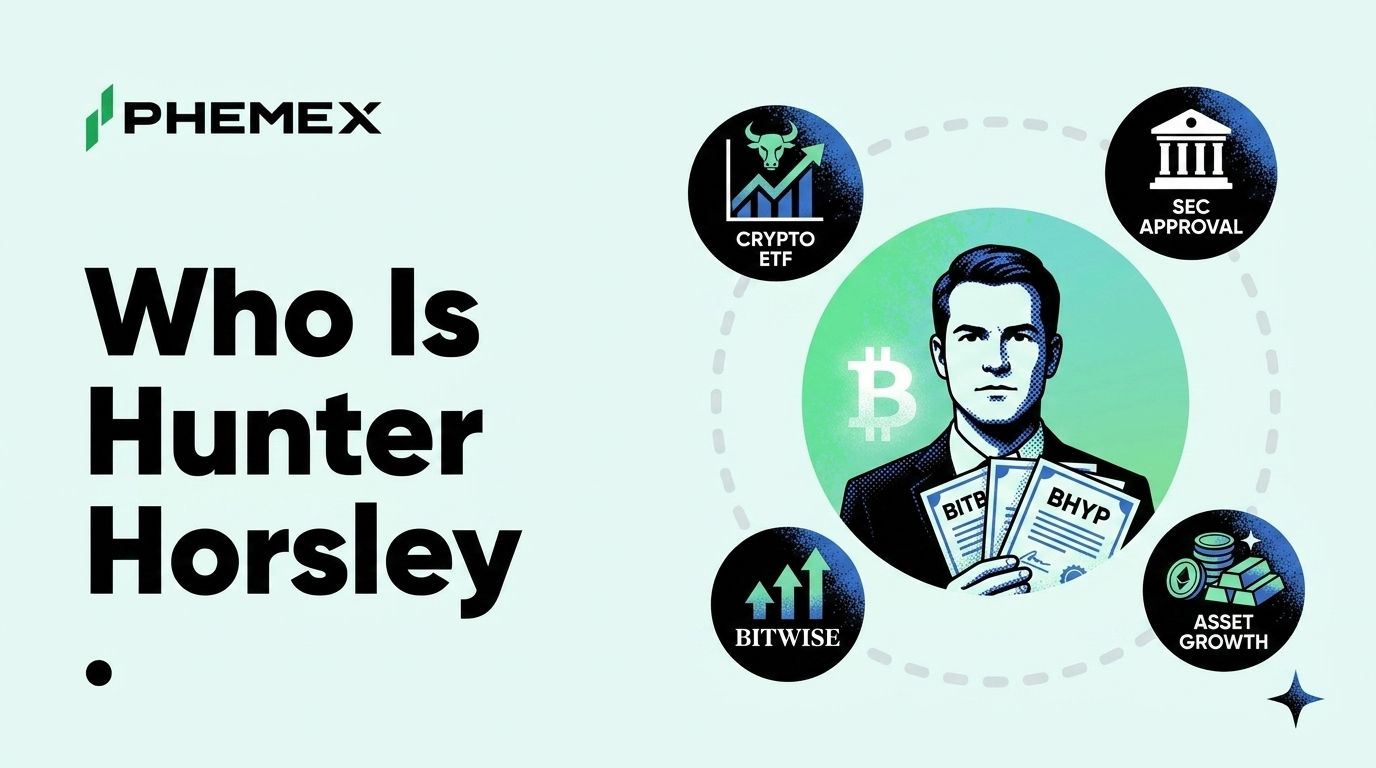
On May 15, 2026, Bitwise listed BHYP on the NYSE, the first US spot exchange-traded fund tracking Hyperliquid and the first crypto ETF anywhere to bundle in-house staking rewards directly into the product. It was a familiar move from a familiar firm. While most issuers fight over Bitcoin and Ethereum, Bitwise keeps showing up first in corners of the market nobody else has reached. The man steering that pattern is Hunter Horsley, the co-founder and CEO who built Bitwise from a single index fund in 2017 into a crypto asset manager overseeing more than $15 billion.
Horsley is not a trader and not a crypto native. He is a former Facebook and Instagram product manager who decided in 2016 that the entire industry was building for the wrong customer, and he has spent the years since proving the point with regulatory approvals other firms could not get.
From Instagram Product Manager to Crypto Fund Builder
Horsley's path into crypto runs through Silicon Valley, not Wall Street. He earned a Bachelor of Science in economics from the Wharton School at the University of Pennsylvania, then joined Facebook as a product manager in July 2015. He worked on video monetization and built features including Branded Content and ad breaks, and he helped launch Facebook Save, a bookmarking tool that picked up more than 300 million users.
He moved to Instagram next, again on the monetization side, during the stretch when Instagram's annual revenue climbed from roughly $70 million to over $1 billion. That is the relevant detail. Horsley spent his formative career years watching a product scale from niche to mainstream, learning exactly what it takes to turn something early and unproven into something ordinary people use without thinking about it.
By 2016 he had become convinced crypto was heading the same way, and he saw a gap nobody was filling. Almost every company in the space was building tools for day traders, developers, and enthusiasts. Nobody was building for the way most people actually buy an asset class, which is through a financial advisor using a regulated product like an ETF, a mutual fund, or a managed account. Horsley left Instagram to build for that customer instead.
How Bitwise Started With One Index Fund
Horsley co-founded Bitwise Asset Management in 2017 alongside Hong Kim, the firm's chief technology officer, who came from a software engineering background and built the early infrastructure. The two of them launched the Bitwise 10 Crypto Index Fund that same year, the first cryptocurrency index fund in the United States. The concept was deliberately boring. Instead of asking investors to pick winners, the fund held a basket of the ten largest crypto assets, rebalanced on a schedule, in a structure a traditional advisor could actually understand and recommend.
That product defined the company. Bitwise was never going to be the flashiest name in crypto, and it was never trying to be. It was building the plumbing that connects regulated capital to digital assets, one approved structure at a time.
The bet took years to pay off. Horsley spent 2018 through 2023 doing the unglamorous work of building research, compliance, and regulatory relationships while the rest of the industry chased token prices. When the US Securities and Exchange Commission finally approved spot Bitcoin ETFs in January 2024, Bitwise was one of the first issuers cleared, launching its Bitcoin ETF, BITB, on day one. The patience had a payoff. Bitwise now manages more than $15 billion across over 30 investment products.
The First-to-Market Strategy That Defines Bitwise
Look at Bitwise's product list and a clear pattern emerges. The firm rarely competes head-on for the biggest, most crowded ETF categories. It moves early into the next category before anyone else has filed.
BITB gave Bitwise spot Bitcoin exposure in the first wave of approvals. Its Ethereum product, ETHW, followed. From there the firm pushed into multi-asset crypto ETFs, single-asset Layer-1 funds, and staking-enabled structures, repeatedly filing for products that did not yet exist as approved categories. Bitwise even proposed binary-outcome ETFs tied to recession and election results, ideas most asset managers would never put their name on.
The logic is straightforward. A first mover in a new ETF category captures the early assets, sets the fee benchmark, and owns the search traffic and advisor mindshare before competitors arrive. When ten Bitcoin ETFs launch the same week, differentiation is nearly impossible and the fight collapses into a fee war. When you are the only Hyperliquid ETF for weeks, you own the entire conversation.
Horsley has paired that product aggression with a strategic build-out of staking infrastructure. In early 2026 Bitwise acquired Chorus One, an institutional staking provider running validators across more than 30 proof-of-stake networks with over $2 billion in staked assets, folding it into a division called Bitwise Onchain Solutions. That acquisition is what made the next move possible. For a closer look at how Bitwise's funds stack up against rivals, this breakdown of crypto ETF strategies for 2026 compares the multi-asset and single-asset approaches side by side.
Why the BHYP Launch Is the Strategy in Action
BHYP is the clearest example yet of how Horsley operates. Hyperliquid is the onchain perpetuals exchange whose HYPE token sits among the ten largest cryptocurrencies by market value, with a market cap around $11 billion. It is exactly the kind of asset that had no regulated wrapper in the US, which made it exactly the kind of asset Bitwise wanted to reach first.
The BHYP launch on May 15 carried two firsts. It was among the first spot Hyperliquid ETPs available to US investors, and it was the first crypto ETF to embed in-house staking, meaning Bitwise stakes the fund's HYPE holdings through Bitwise Onchain Solutions and passes the rewards into the product. That is the Chorus One acquisition paying off directly. The fund carries a sponsor fee of 0.34%, waived to zero for the first month on the first $500 million in assets, a pricing tactic built to grab early market share fast.
Notably, the public commentary on the launch came from Matt Hougan, Bitwise's chief investment officer, who called Hyperliquid one of the most compelling opportunities in crypto. The division of labor is worth understanding. Hougan is the firm's research voice and the analyst quoted in headlines. Horsley is the CEO who decides which products get built and runs the company that ships them. They are two distinct people with two distinct roles, and confusing them misses how Bitwise actually works.
What Horsley Believes About Where Crypto Is Going
Horsley is known for measured, research-driven public communication rather than the hype cycle most crypto executives run on. He does not post price targets for engagement, and his statements tend to be about adoption structure rather than short-term trades.
His core thesis is that crypto is finishing its transition from a fringe asset to an ordinary one. He has said that by the end of 2026 crypto will be mainstream enough that it stops being an interesting topic at all. That belief shapes Bitwise's entire roadmap. If crypto is becoming a normal allocation inside normal portfolios, then the firm that wins is the one offering the widest, cleanest, most regulated menu of ways to hold it.
Staking sits at the center of that view. Horsley's team treats native yield not as a bonus feature but as a structural part of what crypto exposure should include, which is why Bitwise spent real money acquiring validator infrastructure rather than outsourcing it. The Chorus One deal and the BHYP staking model are the same idea expressed twice. The recognition he has collected along the way fits the pattern. Horsley was a Forbes 30 Under 30 honoree in 2019 and has appeared on CoinDesk's Most Influential list, credibility earned by being early and being right rather than by being loud.
Frequently Asked Questions
Who is Hunter Horsley?
Hunter Horsley is the co-founder and CEO of Bitwise Asset Management, a crypto-focused asset manager overseeing more than $15 billion across ETFs, index funds, and other products. Before founding Bitwise in 2017, he was a product manager at Facebook and Instagram. He holds an economics degree from the Wharton School at the University of Pennsylvania.
Is Hunter Horsley the same person as Matt Hougan?
No. Horsley is the co-founder and CEO of Bitwise, while Matt Hougan is the firm's chief investment officer. Horsley runs the company and sets product strategy, and Hougan leads research and is the executive most often quoted in market commentary.
What did Hunter Horsley do at Facebook?
Horsley worked as a product manager at Facebook starting in 2015, building features including Branded Content, ad breaks, and Facebook Save. He later moved to Instagram on the monetization side during the period when Instagram's annual revenue grew from roughly $70 million to over $1 billion.
What is Bitwise's ETF strategy under Horsley?
Bitwise consistently moves first into new crypto ETF categories rather than competing in crowded ones. The approach lets the firm capture early assets, set fee benchmarks, and own advisor attention before rivals file, as seen with its first US spot Hyperliquid ETF, BHYP.
Bottom Line
Horsley's edge is not prediction, it is positioning. He builds the regulated wrapper for the next asset before the rest of the industry agrees the asset matters, and BHYP is simply the latest proof. Watch how fast competing Hyperliquid ETFs reach the market, because the length of Bitwise's head start is the entire value of the strategy. Watch BHYP's asset growth during the fee-free first month, the clearest read on how well first-mover advantage still converts into durable market share. And watch which category Bitwise files for next, because that filing is usually the best available signal of where regulated crypto capital is heading before the rest of the market notices.
This article is for informational purposes only and does not constitute financial or investment advice. Cryptocurrency trading involves substantial risk. Always conduct your own research before making trading decisions.
