










Cardano has spent most of the past three years answering the same question from both directions. Critics call it a "ghost chain" that promised the future and delivered academic papers. Supporters point to its research-first methodology, one of the most decentralized staking systems in crypto, and a governance model that now lets ADA holders vote directly on protocol changes and treasury spending.
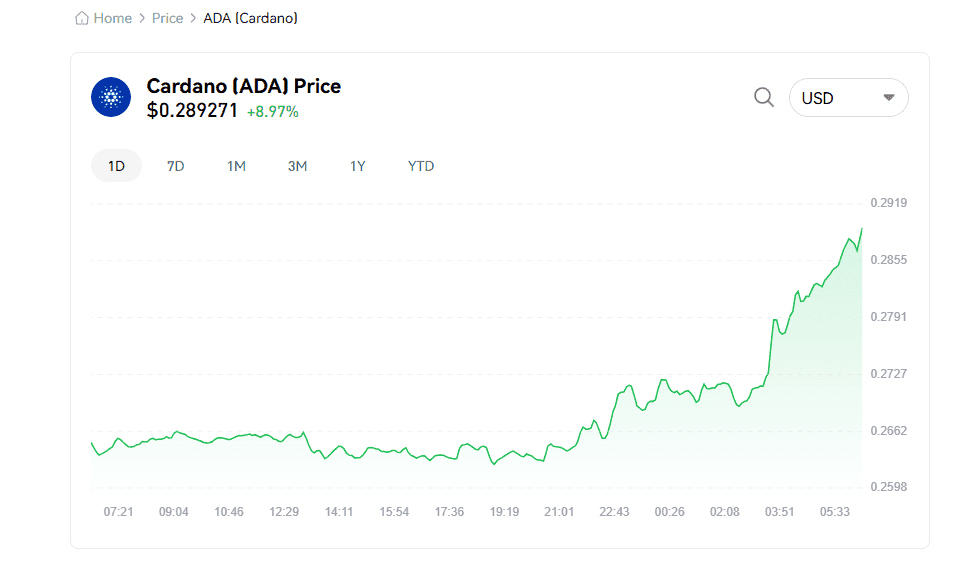
The truth, as it usually does, sits somewhere between those extremes. ADA is trading around $0.27 in mid-March 2026, down more than 90% from its $3.10 all-time high in September 2021. The DeFi ecosystem has grown but remains a fraction of Ethereum and Solana. The developer community is smaller and moves slower. Those are facts.
But 2026 also brought concrete catalysts that did not exist a year ago. CME launched ADA futures in February. A spot Cardano ETF filing is progressing through the SEC under new generic listing standards. The CLARITY Act, if passed, would classify ADA as a digital commodity and remove the regulatory ambiguity that has kept institutional allocators on the sidelines. And Cardano's Voltaire governance era is fully live, making it one of the only layer-1 blockchains where token holders have direct, on-chain control over a treasury worth over $1 billion in ADA.
Here is where Cardano actually stands, what changed, what has not, and what would need to happen for ADA to matter again.
What Is Cardano?
Cardano is a proof-of-stake blockchain platform for smart contracts, created by Ethereum co-founder Charles Hoskinson and launched in 2017. Its native token is ADA, named after 19th-century mathematician Ada Lovelace.
What makes Cardano distinct from Ethereum and Solana is its development methodology. Every protocol upgrade goes through formal academic peer review before implementation, a process borrowed from academic computer science rather than the "ship fast, fix later" approach that dominates most of crypto. The consensus mechanism, called Ouroboros, was the first proof-of-stake protocol to be proven secure through peer-reviewed cryptographic research, published at the CRYPTO 2017 conference.
That research-first philosophy is both Cardano's defining strength and its most debated trade-off. It produces rigorously verified code, but it also means upgrades take longer to reach production than on chains where developers prioritize shipping speed. This tension has defined Cardano's reputation since launch and continues to shape the bear and bull arguments today.
Cardano's development has historically been managed by three organizations (Input Output Global, the Cardano Foundation, and Emurgo), but that structure is gradually transitioning toward full community governance through the Voltaire era.
Where ADA Stands in March 2026
ADA is trading between $0.26 and $0.30 with a market cap around $9.5 billion, placing it in the top 10 by market capitalization. The circulating supply sits at approximately 36 billion ADA out of a maximum supply of 45 billion. Over 63% of all circulating ADA is actively staked across more than 3,000 independent stake pools, one of the highest staking participation rates and the widest pool distribution in crypto.
Total Value Locked (TVL) in Cardano's DeFi ecosystem recently crossed the $552 million mark, growing more than 23% in a 12-day stretch. That is meaningful growth, but for context, Ethereum's TVL sits in the tens of billions and Solana's exceeds $4 billion. The gap is real.
The honest assessment is that ADA has been one of the worst-performing major-cap tokens on a multi-year basis. A 90%+ drawdown from a September 2021 all-time high of $3.10 to under $0.30 in March 2026 represents years of underperformance relative to BTC, ETH, and SOL. For holders who bought the hype cycle, the losses have been significant and prolonged.
Cardano Staking: The Genuine Competitive Advantage
Whatever you think about Cardano's pace of development, its staking system is objectively one of the best-designed in the industry.
No lock-up period. When you delegate ADA to a stake pool, your tokens remain fully liquid and accessible in your wallet at all times. You can sell, transfer, or redelegate at any moment without waiting for an unbonding period.
No slashing risk. Your staked ADA cannot be penalized or reduced for validator misbehavior. You bear zero risk of having your delegated tokens reduced, regardless of what the stake pool operator does.
Extremely decentralized. Over 3,000 active stake pools operate globally, and the protocol's saturation mechanism actively discourages concentration by reducing rewards when a single pool grows too large.
Yield. ADA staking returns currently range from 2.8% to 4.5% APY depending on pool performance and saturation. That compares favorably to the ETHB staking ETF's approximately 2.4% net yield after fees.
These differences are not minor when compared to Ethereum and Solana directly. Ethereum requires 32 ETH (approximately $52,000) to solo-validate, involves slashing risk, and has withdrawal queues. Lido controls over 28% of all staked ETH, creating meaningful centralization risk. Solana requires a multi-day unstaking period and has a smaller, more concentrated validator set. ADA's yield is higher, the staking mechanics are simpler, and the access barrier is lower. The one thing ADA lacks is a U.S. ETF wrapper that makes staking yield accessible to traditional finance, and that is exactly what the pending ETF filing would provide.
What Changed in 2025-2026
Several developments in the past 12 months give Cardano something it has not had in years: a concrete catalyst calendar.
Voltaire governance is fully live. The Chang hard fork in 2025 established on-chain governance, and Cardano now operates one of the most advanced decentralized governance systems in crypto. ADA holders vote directly on protocol upgrades, parameter changes, and treasury spending through Delegated Representatives (DReps), a Constitutional Committee, and stake pool operators. The treasury holds over $1 billion in ADA.
That treasury is now actively funding development through community-voted proposals. The Civics Committee approved the 2026 budget direction in March, and proposals like the Amaru open-source node (a Rust-based Cardano node) and a 50 million ADA venture fund from Draper Dragon are currently in active voting. This is one of the first real-world tests of a billion-dollar decentralized treasury being deployed through genuine community governance rather than foundation grants.
CME launched ADA futures in February 2026. This is significant because CME futures are a regulated institutional product and because the existence of CME futures was a prerequisite for Bitcoin and Ethereum ETF approvals. Having a CME-listed ADA product strengthens the case for a spot ETF and signals that institutional market infrastructure views ADA as a tradable asset at scale.
A spot Cardano ETF is progressing through the SEC. Grayscale, 21Shares, Canary Capital, and other issuers have filed for spot ADA ETFs. Under the SEC's new generic listing standards (approved in 2025), the six-month clock from CME futures launch puts the earliest eligibility window around August 2026. A realistic launch timeline is late Q3 or Q4 2026, assuming issuers have their S-1 registration work substantially complete.
The CLARITY Act would classify ADA as a digital commodity. The bill (H.R. 3633), which passed the House 294-134, would place ADA under CFTC oversight rather than SEC securities enforcement. That commodity classification would remove the regulatory ambiguity that has kept many institutional allocators from touching ADA. The bill is stalled in the Senate over a stablecoin yield dispute, but Polymarket gives it 72% odds of eventual passage.
Technical upgrades continue. Ouroboros Leios, the next-generation consensus protocol aimed at 1,000+ TPS throughput, is under active development with prototype endorsement blocks already built. Hydra, Cardano's layer-2 scaling solution, saw its first non-custodial DEX (Pondora's "Echo") launch. The Midnight privacy sidechain entered early deployment in 2026, and Circle's USDCx (a USDC-backed native stablecoin) is integrating with the Cardano ecosystem to address the chain's historical stablecoin liquidity gap.
The Bull Case for ADA in 2026
Three catalysts converging simultaneously could collectively re-rate ADA in a way that no single event has managed before.
A spot staking ETF approval would bring institutional capital directly into ADA for the first time at scale. The staking yield angle is particularly compelling because ADA's 3-5% with no lock-up and no slashing is a cleaner staking product than ETH's more complex validator economics. An ETF structure that passes through staking yield (as the ETHB staking ETF established precedent for) would give traditional finance investors access to a PoS yield product with genuinely favorable mechanics. And Cardano's 3,000+ stake pools distributing network control is a structural advantage when regulators and institutions increasingly care about concentration risk, a point that Ethereum's Lido dominance and Solana's validator concentration make more relevant, not less.
The CLARITY Act commodity classification would remove the single biggest barrier to institutional adoption. Fund managers, RIAs, and compliance-sensitive allocators currently treat ADA as a potential security exposure. A definitive commodity classification changes the risk calculus entirely.
Voltaire governance proving out adds a third leg to the thesis. If Cardano's community-governed treasury successfully funds meaningful development without gridlock, it demonstrates a model of decentralized coordination that very few protocols have achieved. The early signs are promising: the Amaru node proposal, the Draper Dragon venture fund, and the 2026 budget direction all passed or are actively being voted on with meaningful participation.
The Honest Bear Case
Cardano has been "one upgrade away" from mainstream adoption for five years running. That pattern should temper any optimism about the current catalyst calendar.
The DeFi ecosystem remains tiny by competitive standards. TVL of $552 million is growing but is roughly 1% of Ethereum's and 12% of Solana's. Stablecoin liquidity on Cardano is thin. Circle's USDCx integration could help, but it has not materialized into meaningful on-chain liquidity yet. DeFi protocols like Minswap, SundaeSwap, and Liqwid are operational but handle a fraction of the volume their Ethereum and Solana counterparts process daily.
Developer talent has largely gone elsewhere. The Haskell-based development environment and the eUTxO accounting model (while theoretically more secure) require different engineering patterns than most developers already know. The practical result is a smaller pool of experienced Cardano developers relative to the thousands building on Ethereum L2s and Solana.
The ecosystem that launched after smart contracts arrived in September 2021 never reached the critical mass needed to be self-sustaining at scale. That timing gap, arriving years after Ethereum and roughly concurrent with Solana's explosive growth, meant Cardano was competing for developers and users who had already committed elsewhere.
Price action reinforces the bear case. A 90%+ drawdown over three years, even as BTC and ETH recovered significant ground from their cycle lows, suggests that the market has consistently priced ADA's execution risk higher than its community prices its potential.
How to Trade ADA
ADA/USDT is actively traded on Phemex with deep liquidity on the spot pair. For traders who want to position around the ETF narrative, the CLARITY Act timeline, or Voltaire governance milestones, the key levels to watch are $0.28 resistance (200-day moving average) and $0.24 support (78.6% Fibonacci retracement on the 1-year chart). A sustained break above $0.28 with volume would be the first technical signal of a trend shift.
Frequently Asked Questions
What is Cardano (ADA)?
Cardano is a proof-of-stake blockchain created by Ethereum co-founder Charles Hoskinson and launched in 2017. It uses a peer-reviewed, research-first development approach and the Ouroboros consensus protocol. ADA is its native token, used for transactions, staking, and governance voting.
Is Cardano still relevant in 2026?
Cardano remains a top-10 cryptocurrency by market cap with over 63% of its supply actively staked. Its relevance in 2026 hinges on three pending catalysts: a potential spot ETF approval (earliest window August 2026), the CLARITY Act commodity classification, and how effectively Voltaire governance deploys its $1B+ treasury. The technology works, but adoption remains the open question.
How does Cardano staking compare to Ethereum staking?
ADA staking offers 2.8-4.5% APY with no lock-up, no slashing, and delegation from any wallet to any of 3,000+ stake pools. Ethereum requires 32 ETH ($52K+) for solo validation, involves slashing risk, and has withdrawal queues. ADA's staking mechanics are simpler and more accessible for individual holders.
What would an ADA ETF mean for the price?
A spot staking ETF would create the first regulated, institutional-scale access point for ADA. Bitcoin and Ethereum ETFs both drove significant price appreciation by bringing in capital from investors who had no way to buy the underlying asset. The scale of ADA's response would depend on institutional demand and how compelling the staking yield story proves to be.
Bottom Line
Cardano in 2026 is a network that has delivered on its technical roadmap but has not yet delivered on adoption at the scale its community expected. The governance system works. The staking system is genuinely one of the best in crypto. The security model is sound. But TVL is small, developer activity lags competitors, and three years of 90%+ drawdown from all-time highs is a data point that honest analysis cannot ignore.
The catalyst calendar is the most interesting it has been since ADA peaked. A spot staking ETF, a commodity classification under the CLARITY Act, and a fully operational community treasury worth over $1 billion are not speculative hopes. They are active proceedings with defined timelines. The open question is execution, and execution is exactly where Cardano's track record is most debated.
For traders, the setup is clear: defined catalysts with defined timelines mean defined entry and exit points. For long-term holders, the question is if this time is actually different, or if ADA remains one more upgrade away from the relevance it has been promising since 2021.
This article is for informational purposes only and does not constitute financial or investment advice. Cryptocurrency trading involves substantial risk. Always conduct your own research before making trading decisions.
