









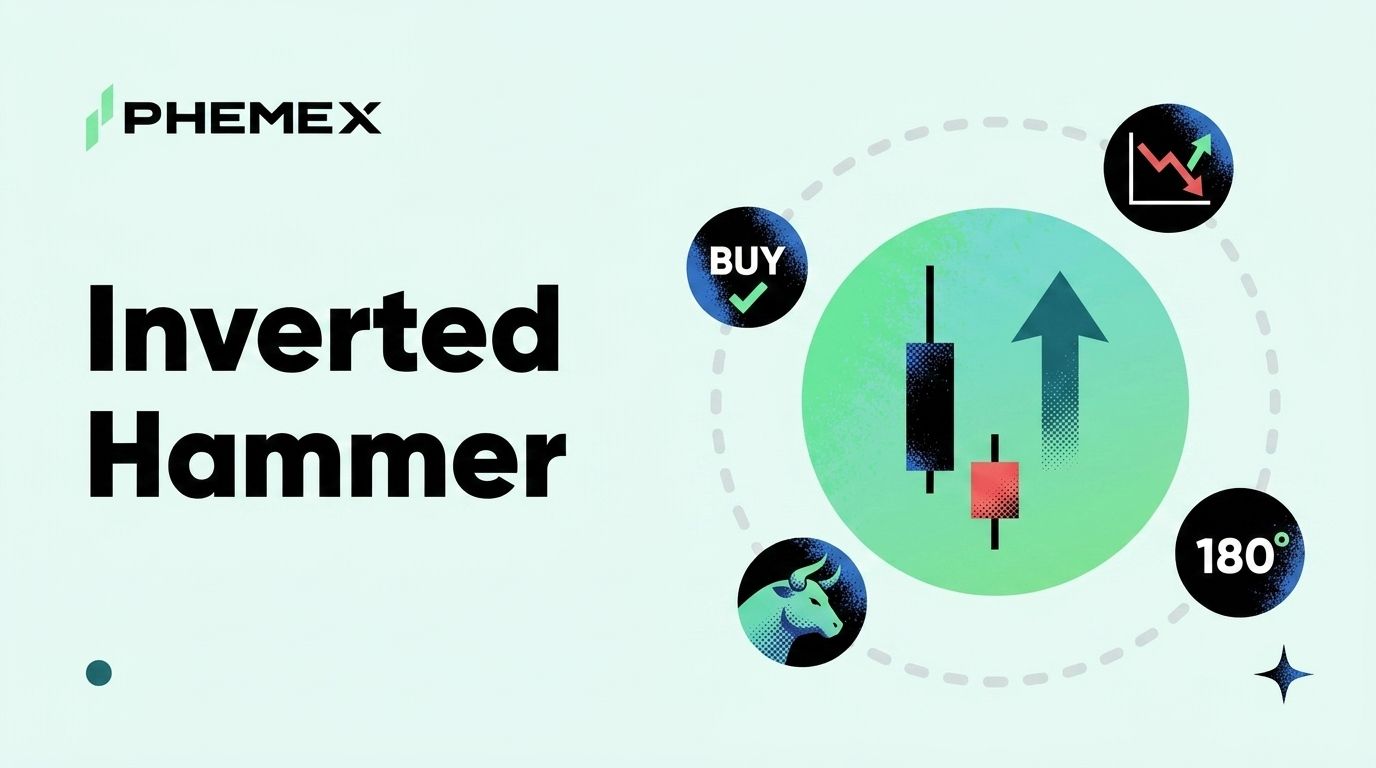
The Inverted Hammer is a single-candle bullish reversal pattern that prints at the bottom of a downtrend, where a small candle body sits near the bottom of the trading range and a long upper wick (at least twice the body length) shows that buyers tried to push the price higher during the session before sellers pushed it back down. The pattern signals that the selling pressure is starting to exhaust because buyers stepped in for the first time in the trend, even though they did not yet hold the gains. Confirmation comes from the next candle, and the setup is structurally one of the cleaner mean-reversion signals available to traders willing to wait for the confirmation rather than front-running the print.
Here is the full anatomy, how to distinguish it from the visually similar Shooting Star and Hammer patterns, and how to trade it on Bitcoin.
The Anatomy of an Inverted Hammer
The Inverted Hammer has three structural components that have to be present for the pattern to qualify. The first is a small candle body that sits near the bottom of the candle's total trading range. The body can be green (a slight rally close above the open) or red (a slight close below the open), and both colors qualify as long as the body is small relative to the wick. The second is a long upper wick that extends at least twice the length of the body. The third is little to no lower wick. The wick should ideally be less than 10 percent of the body length.
Source: Alchemy Markets
The pattern only qualifies as an Inverted Hammer if it prints at the bottom of an established downtrend, and the broader candlestick framework is covered in the Phemex understanding candlesticks patterns guide. The same candle shape printed at the top of an uptrend is a different pattern (the Shooting Star) and carries the opposite bearish signal. The trend context is what determines which pattern label applies, not the candle shape on its own.
The mechanical interpretation is that the long upper wick shows buyers stepped in and pushed the price higher during the session, but the sellers were strong enough to push it back down before the close. The rejection of the lower prices by the buyers is the bullish signal. The sellers winning the close shows the bearish trend is still in control on the surface, which is why the confirmation candle matters.
The Confirmation Rules That Make the Setup Tradeable
The Inverted Hammer on its own is not a tradeable signal. The pattern requires confirmation from the next candle to convert from a pattern observation to a setup with defined risk and reward. The standard confirmation rules are three concurrent conditions on the candle following the Inverted Hammer print.
The first condition is a green candle close above the Inverted Hammer's high. That close confirms that the buyers who stepped in during the Inverted Hammer session are still active and are now holding the gains. The second condition is RSI on the daily timeframe sitting below 30 at the time of the Inverted Hammer print, which confirms the broader oversold structural setup. The third condition is rising volume on the confirmation candle relative to the Inverted Hammer candle, which signals that institutional flow is participating in the reversal rather than just retail.
When all three conditions align, the historical hit rate on Bitcoin daily Inverted Hammers across 2017 through 2025 is roughly 64 percent for a 5 to 10 percent rally over the following 5 to 10 trading days, per the broader candlestick reversal pattern data sets compiled by Investopedia's Inverted Hammer reference and other technical analysis references. The hit rate drops sharply when one or more confirmation conditions are missing, which is why disciplined waiting matters.
How to Distinguish the Inverted Hammer From the Shooting Star
The Inverted Hammer and the Shooting Star are visually identical candles. The same small body, the same long upper wick, the same minimal lower wick. The only difference is the trend context. An Inverted Hammer prints at the bottom of a downtrend and signals bullish reversal. A Shooting Star prints at the top of an uptrend and signals bearish reversal.
The trend context test is straightforward. If the candle prints after a sustained move down (typically defined as a meaningful drop over the prior 10 to 20 candles), the pattern is an Inverted Hammer and the signal is bullish. If the candle prints after a sustained move up over the same window, the pattern is a Shooting Star and the signal is bearish. Both patterns require their respective confirmation candles, but the directional implication is opposite. The StockCharts ChartSchool candlestick reference covers the broader pattern taxonomy in detail.
The most common error traders make with these patterns is misidentifying the trend context. A candle that prints during a sideways range is neither an Inverted Hammer nor a Shooting Star in a meaningful sense, because there is no trend to reverse. The pattern only carries signal value when the trend context is clear.
How to Distinguish the Inverted Hammer From the Hammer
The Hammer pattern is a different bullish reversal candle with the opposite anatomy. The Hammer has a small body near the top of the trading range and a long lower wick. The mechanical interpretation is similar (sellers pushed the price lower during the session before buyers pushed it back up), but the directional asymmetry of the wick changes the implication.
The Hammer is the cleaner bullish signal of the two patterns because the close near the top of the range means the buyers held control by the end of the session. The Inverted Hammer is the weaker signal because the close near the bottom of the range means the sellers still won the immediate battle, even though the buyers showed up during the session.
Practically, the Phemex Hammer candlestick guide covers the Hammer pattern in full detail, and the comparison between the two patterns matters for sizing decisions. An Inverted Hammer with confirmation deserves a smaller initial position than a Hammer with confirmation, because the historical hit rate is meaningfully different.
A Worked Bitcoin Example
Consider a hypothetical Bitcoin example at recent support levels. BTC has been trending down for two weeks from $66,000 to $58,000 and prints a daily candle with an open at $58,500, a high at $61,200, a low at $57,800, and a close at $58,200. The body (open to close) is $300. The upper wick (high to body top) is $2,700. The lower wick (body bottom to low) is $400.
The candle qualifies as an Inverted Hammer because the body is small relative to the wick, the upper wick is roughly nine times the body length, the lower wick is minimal, and the candle prints at the bottom of an established downtrend. The next-candle confirmation rule requires a green close above $61,200 (the Inverted Hammer high), which would be the trigger to enter the trade.
The standard trade structure would be entry on the next-candle close above $61,200, stop placement below the Inverted Hammer low at $57,800, and the first target at the prior resistance level (typically the level where the downtrend started or a 50 percent Fibonacci retracement of the downtrend). The reward to risk ratio at the entry typically runs between 2.5 to 1 and 4 to 1 depending on where the first resistance sits, which is the asymmetry that makes the pattern worth waiting for confirmation.
Frequently Asked Questions
What is the historical hit rate on Inverted Hammers in crypto?
The Bitcoin daily Inverted Hammer hit rate with full confirmation runs roughly 64 percent across the 2017 through 2025 data set for a 5 to 10 percent rally over the following 5 to 10 trading days. The hit rate drops to roughly 38 percent without confirmation, which is why waiting for the next-candle close above the Inverted Hammer high is the disciplined approach.
Can the Inverted Hammer work on lower timeframes like the 4-hour chart?
It can, but the hit rate degrades sharply below the daily timeframe because noise in lower-timeframe candles produces more false signals. The 4-hour Inverted Hammer is usable for short-term swing setups but should not be sized as aggressively as the daily print. The weekly timeframe produces the cleanest historical hit rates but the signals are rare.
How does the Inverted Hammer compare to other bullish reversal patterns?
The Hammer is the stronger single-candle bullish signal because the close is near the top of the range. The Bullish Engulfing pattern is the strongest two-candle bullish signal because both candles confirm the trend change. The Inverted Hammer is the weaker single-candle bullish signal but still tradeable with proper confirmation and risk management.
What invalidates the Inverted Hammer setup?
A red close on the confirmation candle below the Inverted Hammer's low invalidates the pattern entirely. A close above the Inverted Hammer high that does not hold above that level on the third candle is a weaker invalidation but still warrants risk reduction or position closure. The stop placement below the Inverted Hammer low is the clean structural invalidation level.
Bottom Line
The Inverted Hammer is a single-candle bullish reversal pattern that prints at the bottom of a downtrend with a small body, a long upper wick at least twice the body length, and minimal lower wick. The pattern signals that buyers stepped in for the first time in the trend, but the sellers still won the close, which makes the confirmation candle structurally important to converting the observation into a tradeable setup.
The confirmation rules require a green close above the Inverted Hammer high, RSI below 30 at the print, and rising volume on the confirmation candle. The historical hit rate with full confirmation runs roughly 64 percent for a 5 to 10 percent rally over the following 5 to 10 trading days on the Bitcoin daily timeframe. The clean structural invalidation is a close below the Inverted Hammer low, which is also the standard stop placement that produces the typical 2.5 to 1 or better reward-to-risk asymmetry.
This article is for informational purposes only and does not constitute financial or investment advice. Cryptocurrency trading involves substantial risk. Always conduct your own research before making trading decisions.
